
- dtlta-Kitchens
Short-Term Kitchen Rental for Seasonal Food Businesses
Quick AnswerA short-term kitchen rental is best for seasonal food businesses that need temporary production capacity without committing to a permanent commercial facility. The right kitchen should match your production volume, equipment needs, storage requirements, regulatory obligations, and scheduling window. Before booking, compare the total cost of access, including storage, cleaning, equipment, utilities, deposits, and cancellation terms. Confirm that the facility supports your specific food process, test the space before peak season, and calculate the true cost per production cycle rather than judging the rental by its hourly rate alone. |
Seasonal food businesses often need more production capacity for a limited period without taking on the cost and commitment of a permanent commercial kitchen. A short-term kitchen rental can provide licensed workspace, professional equipment, and flexible access during peak production periods.
The challenge is choosing a facility that fits the business’s volume, schedule, storage requirements, and regulatory obligations without creating unnecessary operating costs. This blog explains how short-term kitchen rentals work, what to evaluate before booking, and how seasonal food businesses can select the right space for temporary production.
When Does a Short-Term Kitchen Rental Make Sense for a Seasonal Food Business?
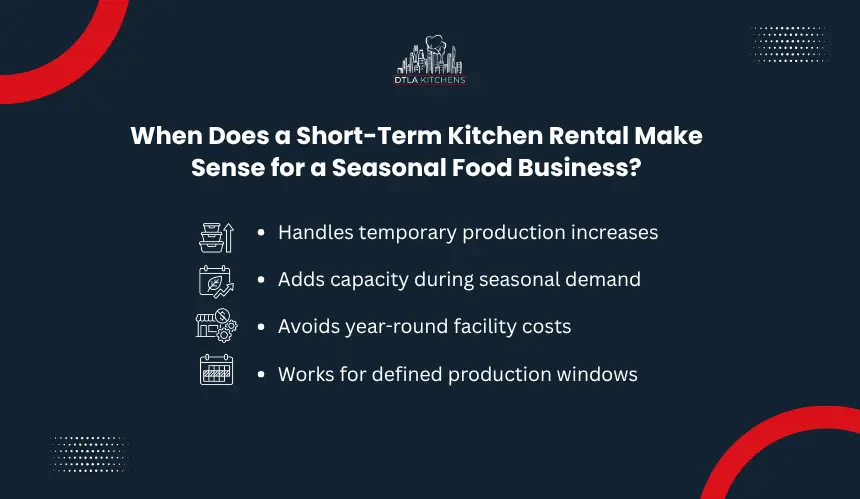
A short-term kitchen rental makes sense when production demand increases temporarily but does not justify a permanent facility. The model is most effective when a business can match rented kitchen hours to a defined seasonal production window and avoid paying for unused capacity outside that period.
When Does Seasonal Demand Create a Need for Temporary Kitchen Space?
Temporary kitchen space is useful when sales volume rises around predictable periods such as holidays, festivals, farmers market seasons, catering cycles, or limited-time product launches. These demand spikes can exceed the capacity of a home kitchen, small prep area, or existing commercial workspace.
A rented commercial kitchen gives the business access to additional prep surfaces, cooking equipment, refrigeration, and compliant production space only when higher output is required. This makes capacity easier to scale without adding a long-term lease or permanently expanding fixed overhead.
Short-Term Rental vs. Maintaining a Permanent Commercial Kitchen
The main difference is commitment. A permanent commercial kitchen creates ongoing expenses such as rent, utilities, maintenance, insurance, equipment servicing, and facility management even during slower months.
A short-term rental converts part of that fixed cost into a variable operating expense tied more closely to actual production. For businesses with concentrated seasonal revenue, this can improve cost control because kitchen access is purchased for specific days, weeks, or production blocks instead of maintained year-round.
The tradeoff is control. Permanent facilities offer dedicated access and predictable availability, while shared or short-term kitchens may involve booking limits, shared equipment, and restricted storage.
When Is a Short-Term Kitchen Rental Not the Right Fit?
Short-term kitchen space may be unsuitable when production runs continuously, storage requirements are substantial, or the business depends on specialized equipment that shared facilities do not provide. It can also become inefficient when rental hours accumulate to the point that a longer-term lease offers a lower effective cost.
Businesses that require unrestricted access, permanent ingredient storage, dedicated production lines, or frequent daily use should compare short-term rental costs against dedicated commercial space before committing.
What Should You Look for in a Short-Term Commercial Kitchen Rental?
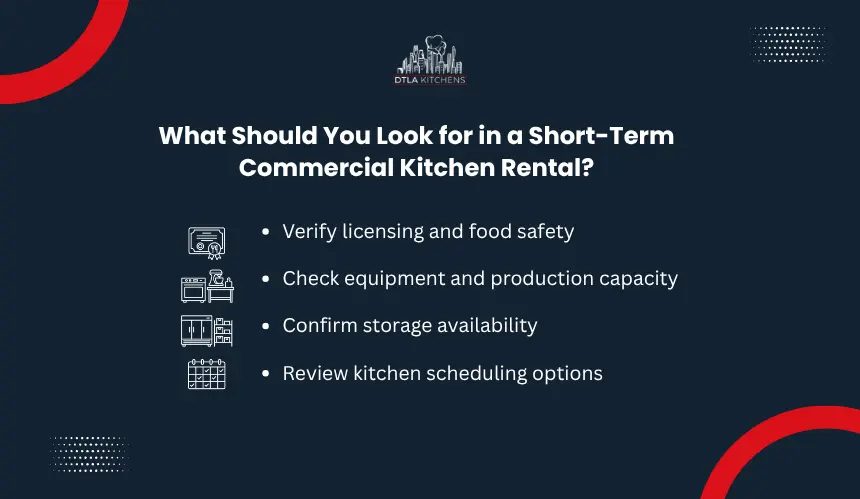
A suitable rental kitchen must support the business’s actual production process, not just provide commercial-grade space. The strongest fit depends on regulatory compatibility, equipment capacity, storage access, and whether the facility can accommodate the required production schedule.
Licensing, Food Safety, and Local Regulatory Requirements
The kitchen must be appropriate for the type of food being produced and the permits under which the business operates. A licensed commercial kitchen does not automatically mean every tenant, process, or product is covered under the same regulatory approval.
Businesses should verify whether the facility meets applicable health department requirements, whether additional permits are needed, and whether specific processes such as baking, hot food preparation, cooling, packaging, or allergen-controlled production are permitted. The kitchen’s sanitation procedures, handwashing stations, warewashing setup, ventilation, and food-contact surfaces should also match the operational requirements of the business.
Regulatory compatibility should be confirmed before production begins because a facility that cannot support the intended process can create approval delays, inspection issues, or restrictions on what can legally be produced there.
Equipment and Production Capacity
Equipment should be evaluated by capacity, availability, and compatibility with the production workflow. A kitchen may have commercial ovens, ranges, mixers, fryers, prep tables, and sinks, but those assets only add value if they can handle the expected batch volume within the rented time.
Seasonal operators should assess oven capacity, burner count, mixer size, refrigeration throughput, electrical supply, ventilation, and usable prep space. Shared equipment also needs to be considered operationally. If a key appliance is available to multiple tenants, access during peak hours may limit output even when the kitchen itself appears well equipped.
The goal is to determine how much finished product can realistically be produced per booked session rather than judging the facility by its equipment list alone.
Refrigerated, Frozen, and Dry Storage
Storage affects both production efficiency and food safety. Ingredients, prepared products, packaging materials, and finished goods may need to remain on-site between production sessions, especially when demand is concentrated over several days.
Businesses should confirm how much refrigerated, frozen, and dry storage is included, whether storage is dedicated or shared, and whether access is available outside scheduled kitchen hours. Shelf dimensions, temperature control, labeling rules, security, and additional storage fees can also affect whether the space supports the intended workflow. Limited storage can force more frequent deliveries, off-site inventory management, or additional transportation between production runs, increasing labor and handling costs.
Kitchen Availability and Scheduling
Scheduling determines whether the kitchen can support production at the times the business actually needs it. Seasonal demand often creates concentrated booking pressure, particularly before holidays, weekends, market days, and major events.
Operators should review reservation windows, minimum booking periods, recurring time-slot availability, overnight access, cancellation rules, and how far in advance peak periods can be secured. Access for setup, cooling, packaging, and cleanup should also be included when estimating the required booking time. A kitchen with the right equipment but unreliable access can still create production bottlenecks. Consistent scheduling is therefore a capacity issue, not simply a convenience.
How Do Short-Term Kitchen Rental Costs and Agreements Work?
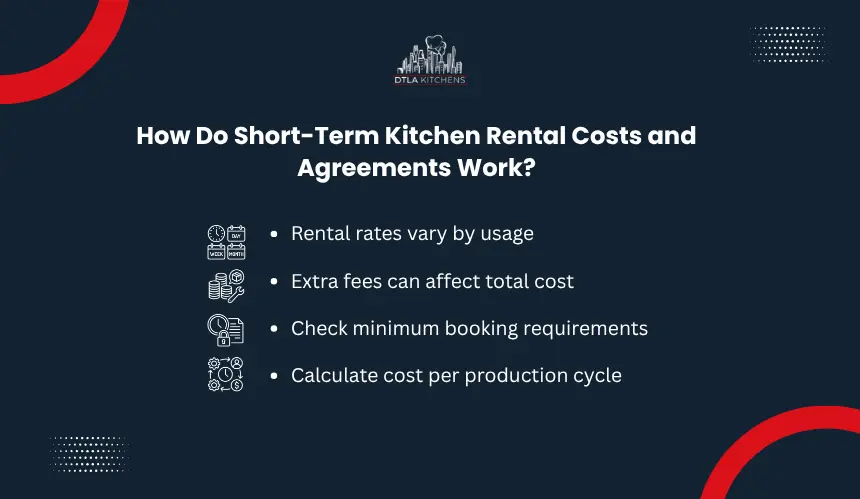
Short-term kitchen rental costs depend on how the facility charges for access, what services are included, and how intensively the business uses the space. The lowest advertised rate is not always the lowest operating cost, so seasonal businesses should evaluate the full agreement rather than comparing base prices alone.
Hourly, Daily, Weekly, and Monthly Rental Structures
Commercial kitchens may charge by the hour, shift, day, week, or month. Hourly pricing usually suits businesses with limited or irregular production, while daily or weekly arrangements can be more economical when output is concentrated into longer production blocks.
Monthly access may make sense when a seasonal business needs frequent use over several consecutive weeks. However, the value depends on how many hours are actually used. A lower monthly rate can still create wasted expense if production is inconsistent. The best rental structure is the one that aligns cost with the business’s production frequency, batch size, and seasonal sales window.
What Costs Can Be Added Beyond the Base Rental Rate?
The quoted kitchen rate may exclude expenses that materially change the total cost of production. Common additional charges can include cold or dry storage, equipment use, cleaning, waste disposal, utilities, security deposits, onboarding fees, and extended access.
Some facilities also charge separately for specialty appliances, overnight storage, receiving deliveries, or using designated production areas. These expenses should be identified before comparing facilities because two kitchens with similar hourly rates can have very different all-in costs. A complete cost estimate should include every recurring and one-time charge tied to the planned production period.
Minimum Commitments, Cancellation Policies, and Access Rules
Short-term agreements often contain operational restrictions that affect flexibility. A kitchen may require minimum booking hours, recurring reservations, advance payment, or a fixed number of sessions within a specified period.
Cancellation terms also matter during seasonal operations because weather, event changes, supplier delays, or fluctuating demand can alter production plans. Businesses should confirm notice periods, refund policies, rescheduling rules, and whether unused time can be transferred. Access rules should be reviewed at the same time, including permitted operating hours, guest or employee access, loading procedures, cleanup responsibilities, and restrictions on shared equipment.
How Do You Calculate the True Cost per Production Cycle?
The most useful cost measure is the amount spent to complete a full production cycle, not simply the hourly rental rate. That calculation should include kitchen time, labor, storage, equipment charges, cleaning, transportation, and any facility-specific fees required to produce the finished batch.
For example, a lower-cost kitchen may become more expensive if limited equipment extends production by several hours. A higher hourly rate may deliver better value when greater capacity allows more units to be produced in the same time. Seasonal businesses should compare total kitchen-related cost against expected batch output to determine the effective facility cost per unit, order, or production run.
How Should Seasonal Food Businesses Match a Kitchen to Their Production Model?
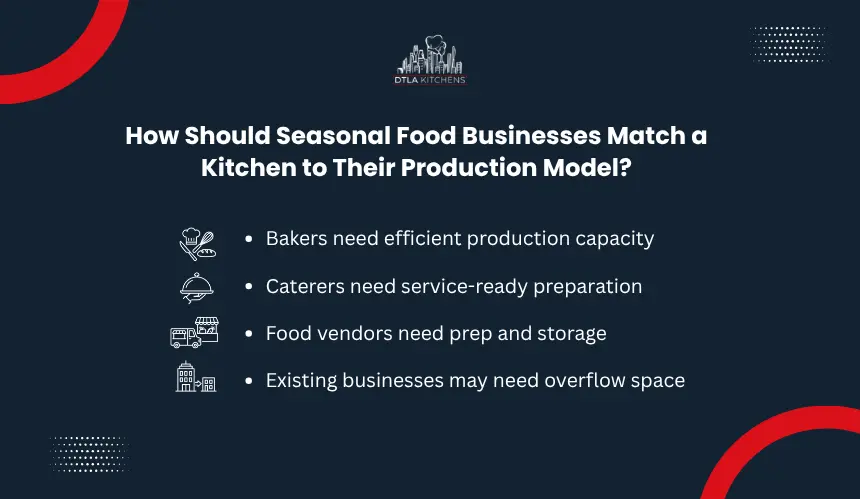
The right short-term kitchen depends on how the business produces, stores, stages, and distributes food during its seasonal window. Different operating models create different demands for equipment, workspace, access timing, and product handling.
Holiday Bakers and Seasonal Product Producers
Holiday bakers often need concentrated production capacity over a short period, making workflow efficiency especially important. Oven throughput, mixer size, cooling racks, sheet-pan storage, packaging space, and ingredient staging can determine how many batches can be completed during each rental period.
Businesses producing cookies, pies, breads, confections, or gift-box items should also consider how finished products move from baking to cooling, decorating, packaging, and temporary storage. A kitchen that supports each stage in sequence can reduce idle time and prevent finished goods from competing with active production for workspace.
Caterers, Pop-Ups, and Event-Based Food Businesses
Caterers and pop-up operators need kitchens that support preparation around fixed service deadlines. Batch cooking, rapid cooling, portioning, staging, and transport readiness are often more important than continuous daily access.
Loading access, proximity to event routes, refrigeration for prepared food, and enough counter space for assembly can directly affect execution before service. Kitchens that allow production close to event time can also reduce unnecessary holding periods and limit additional handling between preparation and delivery.
For event-driven businesses, the operational question is whether the facility can move food efficiently from prep to departure without creating delays at the final staging point.
Food Trucks and Farmers Market Vendors
Food trucks and market vendors often use commissary or shared kitchens as a support base for preparation tasks that cannot be completed efficiently at the point of sale. Common needs include ingredient prep, batch cooking, dishwashing, water handling, waste disposal, and refrigerated storage between service periods.
Early access can be especially valuable when products must be loaded before morning markets or service routes. Vendors should also consider whether the kitchen supports receiving supplies, storing bulk ingredients, and preparing enough inventory for multiple selling periods without excessive return trips.
The best fit is a kitchen that functions as an operational extension of the mobile or market-based business rather than simply as a place to cook.
Temporary Expansion for Existing Food Businesses
Established restaurants, bakeries, meal-prep companies, and packaged-food producers may use short-term kitchens when seasonal orders exceed the capacity of their primary facility. In this case, the rental space functions as overflow capacity rather than the main production site.
The secondary kitchen should be selected based on which production tasks can be separated from the core operation without creating unnecessary transfers between locations. For example, a business may move bulk prep, baking, sauce production, or packaging to the rented facility while keeping final assembly and service at its primary site.
This approach is most effective when the additional space removes a specific bottleneck and increases output without fragmenting the production process.
How Can You Prepare for a Short-Term Kitchen Rental Before Seasonal Production Begins?
Preparation should convert the rented kitchen from an available space into a predictable production system. Before peak demand begins, businesses should complete required documentation, map the production workflow, validate the facility under real operating conditions, and plan how the rental period will close.
Confirm Permits, Insurance, and Facility Requirements
Before the first production session, verify that all business-specific documentation required by the facility is complete. This may include permits, food-handler credentials, liability insurance, business registration records, and any onboarding forms required by the kitchen operator.
The goal at this stage is administrative readiness. Even when the kitchen itself is properly licensed, the tenant may still need separate approvals or proof of compliance before using the space commercially.
Businesses should also confirm any operating conditions attached to access, such as approved product categories, staff authorization, sanitation responsibilities, key or entry procedures, and documentation needed for deliveries or inspections.
Create a Production and Kitchen-Use Schedule
A production schedule should account for the full workflow, not only active cooking time. Prep, baking or cooking, cooling, assembly, packaging, sanitation, and equipment reset all consume rental hours.
Seasonal operators can reduce scheduling errors by estimating each stage separately and then assigning realistic time blocks. This makes it easier to identify whether one session can support the required batch volume or whether production should be divided across multiple bookings.
The schedule should also account for dependencies. For example, cooling time may delay packaging, and cleaning requirements may prevent equipment from being used continuously between batches.
Test the Kitchen Before Peak Season
A trial production session can reveal operational problems that are difficult to identify from a facility tour. Businesses should use the test run to measure actual batch times, confirm equipment performance, evaluate workspace flow, and determine whether staff can move efficiently between preparation, cooking, cooling, and packaging.
The trial should also identify missing tools, electrical limitations, insufficient staging space, or workflow conflicts that could reduce output during peak demand.
Recording actual production times during the test run creates a more reliable basis for future bookings than estimating capacity from equipment specifications alone.
Plan for the End of the Seasonal Rental Period
The rental exit should be planned before the final production week. Businesses need to determine when ingredients, packaging materials, stored products, and business-owned equipment will be removed from the facility.
Final cleaning responsibilities, storage termination dates, deposits, outstanding charges, and access deadlines should also be confirmed in advance. This reduces the risk of paying for unused storage or missing obligations after production has ended.
If the business expects to return during the next seasonal cycle, reviewing performance data from the current rental can also inform future booking length, production timing, and space requirements.
Need flexible commercial kitchen space for your next seasonal rush? DTLA Kitchens offers part-time, full-time, bakery, ice cream, kosher, and studio kitchen options designed for food businesses across Southern California. Find a kitchen that fits your production needs, schedule, and growth plans without taking on more space than you need.
Frequently Asked Questions
Usually, the facility’s policy protects the kitchen operator and property, not every independent tenant’s products or business liabilities. Many commissary kitchens require renters to carry separate general or product liability insurance and name the facility as an additional insured. Coverage requirements should be confirmed before signing the rental agreement.
Shared kitchens can support allergen-sensitive production only when cross-contact risks are adequately controlled. FDA guidance identifies shared equipment, production scheduling, sanitation, storage, and handling as relevant allergen-control factors. Businesses making gluten-free or allergy-related claims should evaluate dedicated tools, cleaning protocols, ingredient separation, and the facility’s other tenants.
A failed health, fire, occupancy, or building inspection can restrict access even when the tenant itself has complied with operating rules. That can interrupt production, strand inventory, or force an emergency relocation. Before peak season, ask how the agreement handles facility closures, refunds, stored goods, and alternative workspace.
A shared facility can host multiple independent food businesses, but each operator may still need its own approvals, permits, insurance, and commissary documentation. Approval of the physical kitchen does not automatically authorize every tenant using it. Local regulators may review each business according to its menu, production activities, and sales model.
Possibly, but production location and sales jurisdiction can trigger different regulatory requirements. A kitchen approved in one county does not automatically satisfy permits for temporary events, mobile vending, catering, or wholesale distribution elsewhere. Confirm requirements with both the agency regulating the production facility and the jurisdiction where food will be sold.
Only when the facility permits that use, and the relevant regulator accepts the address for the specific purpose. A commissary address may be required on certain permit documents, but that does not automatically make it a mailing address, registered business address, or customer-facing location. Confirm address rights before printing packaging or submitting applications.
That depends on the facility’s receiving policy rather than kitchen access alone. Some kitchens accept scheduled deliveries, while others require the tenant to be present. Ask who signs for goods, where refrigerated items are placed, how deliveries are labeled, and whether receiving or temporary storage generates additional charges.