
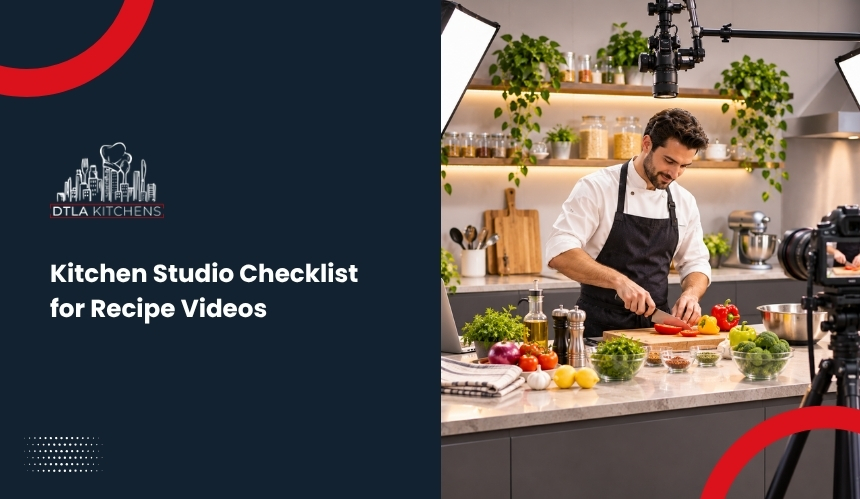
- DTLA Kitchens
Kitchen Studio Checklist for Recipe Videos
Quick AnswerA kitchen studio for recipe videos should support cooking, filming, food styling, and crew movement without creating production conflicts. Before booking, confirm that the space has the right appliances, refrigeration, water, power, ventilation, lighting control, camera clearance, and audio conditions for the planned recipes. The studio should also provide practical areas for ingredient staging, plating, backup dishes, and resets between takes. Recipe testing, shot-list planning, and sufficient booking time for setup and cleanup can reduce delays, while reviewing rental inclusions, overtime policies, insurance requirements, and extra fees helps prevent unexpected production costs. |
A kitchen studio can either streamline recipe video production or create delays through poor layout, limited equipment access, inconsistent lighting, and inefficient prep space. The right setup must support cooking, filming, food styling, audio capture, and crew movement without creating operational conflicts.
For recipe creators and production teams, evaluating these conditions before filming reduces reshoots, setup delays, and workflow interruptions. This blog provides a practical kitchen studio checklist to help you assess whether a space is properly equipped for efficient, professional recipe video production.
Kitchen Studio Space and Layout Checklist for Recipe Videos
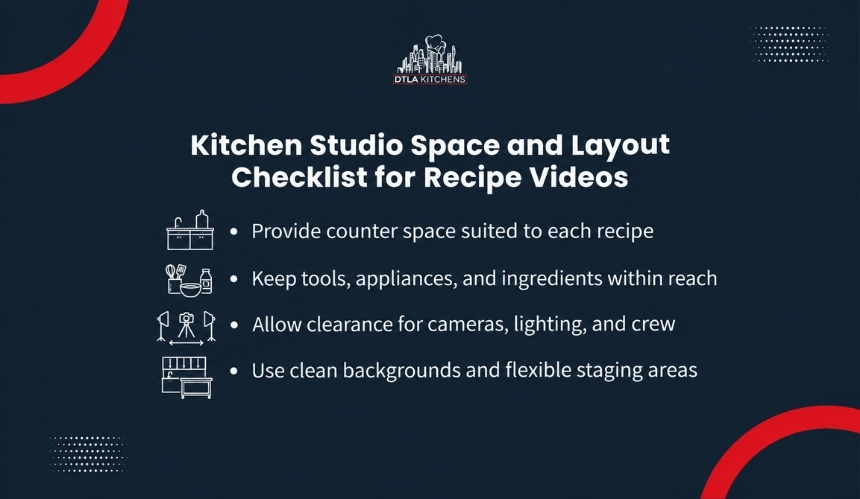
A recipe video kitchen studio needs enough usable space to support food preparation, filming, equipment placement, and crew movement at the same time. Layout problems become production problems when cameras block work areas, cooking stations restrict framing, or crew members cannot move without interrupting a take.
Cooking and Preparation Workspace
The cooking area should provide enough counter space to prepare ingredients, organize utensils, and complete multiple recipe steps without repeatedly clearing the work surface. Frequently used tools, appliances, and ingredients should remain within practical reach so the presenter can move through each stage of the recipe without unnecessary pauses or off-camera retrieval.
The workspace should also match the type of recipe being filmed. Stove-based demonstrations require accessible burners and safe working clearance, while baking content often needs larger preparation surfaces, mixer space, and reliable oven access. Sink placement should support washing and cleanup without interfering with the primary cooking or filming zone.
Camera, Crew, and Equipment Clearance
A kitchen may function well for cooking but still be unsuitable for recipe video production if there is insufficient clearance for cameras, tripods, lighting stands, and crew members. Equipment should be positioned without blocking appliances, cabinet doors, workstations, or the presenter’s movement between preparation and cooking areas.
Additional clearance becomes necessary when the production uses multiple camera angles. Front-facing shots, side views, close-ups, and moving camera positions may all require access around the same workstation. Adequate circulation space allows operators to adjust framing and equipment without entering the shot or forcing the cooking process to stop.
Background and Set Flexibility
The visible background should support the visual style of the recipe without introducing distracting equipment, clutter, reflective surfaces, or unrelated objects. Clean cabinetry, neutral finishes, open shelving, and controlled decorative elements can create a consistent frame while keeping visual attention on the presenter and food.
Set flexibility also affects how efficiently the kitchen studio can support different types of recipe content. Movable tables, interchangeable props, adjustable surfaces, and flexible staging areas allow the production team to shift between demonstrations, plated food shots, overhead compositions, and branded setups without rebuilding the entire set.
Cooking Equipment and Food Preparation Checklist
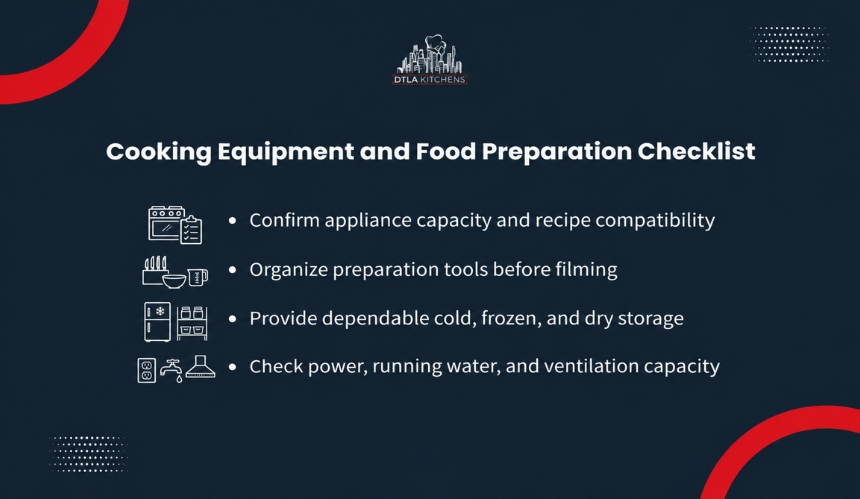
A kitchen studio for recipe videos needs cooking equipment and food-handling infrastructure that can support the recipe exactly as planned. Missing appliances, limited storage, or inadequate utilities can force substitutions during production and create continuity problems between preparation, cooking, and final presentation.
Essential Cooking Appliances
The studio should have the core appliances required for the recipes being filmed, including an appropriate range or cooktop, oven, refrigerator, freezer, and any specialty equipment used during preparation. Appliance capacity also matters. A compact oven or limited burner configuration may work for simple demonstrations but become restrictive when several components need to cook simultaneously.
Check appliance specifications before production rather than assuming every kitchen setup will meet the recipe requirements. Induction cookware compatibility, oven temperature range, refrigerator capacity, and access to countertop appliances such as food processors, stand mixers, or blenders can directly affect how closely the filmed process follows the intended recipe.
Prep Tools, Surfaces, and Storage
Food preparation requires more than an available countertop. The studio should provide suitable cutting boards, knives, mixing bowls, measuring tools, cookware, baking equipment, and utensils for each stage of the recipe. Having these tools organized before filming reduces interruptions and prevents the presenter from breaking continuity to locate missing equipment.
|
The FDA Food Code uses 41°F (5°C) or below as the cold-holding benchmark for time and temperature control for safety foods. Checking refrigerator temperature before filming gives production teams a measurable standard for storing perishable ingredients rather than relying on whether the unit simply feels cold. |
Storage should accommodate ingredients according to their handling requirements. Refrigerated products need dependable cold storage, frozen items require freezer capacity, and dry ingredients should have an organized staging area away from active preparation surfaces. Proper separation keeps ingredients accessible while reducing clutter around the cooking station.
Utilities and Kitchen Functionality
Reliable utilities determine whether cooking and production equipment can operate together without disruption. Electrical outlets should support countertop appliances and other kitchen equipment at the required load, while running water must remain accessible for ingredient preparation, sanitation, and cookware handling throughout the shoot.
Ventilation is particularly relevant when recipes produce heat, smoke, grease, or steam. An effective hood or extraction system controls airborne moisture and cooking by-products before they affect visibility, surfaces, or working conditions. Confirming water, power, and ventilation capacity before filming reduces the risk of operational interruptions once active cooking begins.
Food Styling and On-Camera Presentation Checklist
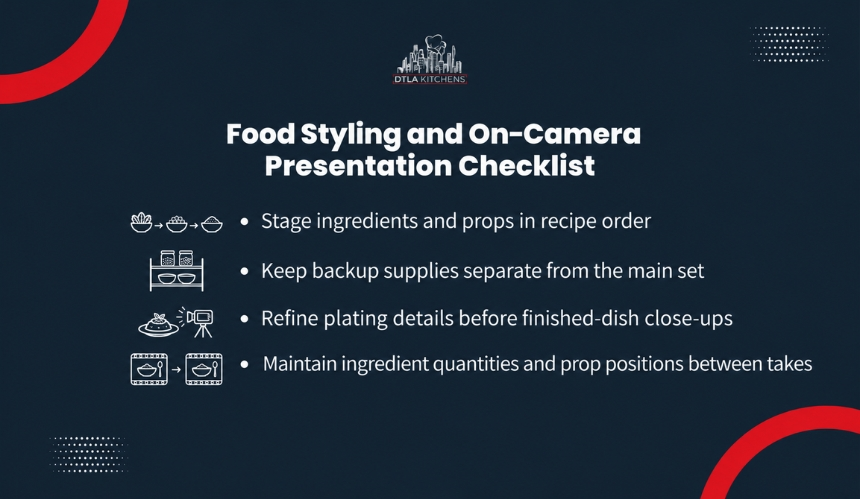
Recipe videos need a controlled presentation process so ingredients, cookware, and finished dishes remain visually consistent from one shot to the next. Styling decisions should support clarity on camera while preserving the natural appearance of the food throughout preparation and final presentation.
Did you know? Food can change appearance within minutes under studio conditions as heat, moisture loss, oxidation, and melting affect texture, color, and shine. Preparing backup portions and timing hero shots carefully can help maintain visual consistency across multiple takes.
Ingredient and Prop Staging
Ingredients should be staged in the order they appear in the recipe so the presenter can access each item without breaking the sequence of the demonstration. Bowls, utensils, cookware, serving pieces, and branded props should also be positioned before recording begins, with unnecessary items kept outside the active frame.
A separate staging area gives the production team room to organize replacement ingredients, clean props, garnishes, and backup utensils without crowding the primary set. This separation also allows adjustments to be made between takes while keeping the visible cooking surface consistent for the camera.
Finished-Dish Presentation
The final dish should be plated in an area that gives the food stylist enough control over portion placement, garnish, sauce application, and surface cleanliness. Small visual details become more noticeable in close-up footage, so plate edges, drips, crumbs, and uneven garnishing should be corrected before hero shots are recorded.
Presentation surfaces and serving pieces should complement the food rather than compete with it. Plate color, background texture, utensil placement, and garnish scale can affect contrast and visual separation, particularly in tight compositions. A dedicated presentation area makes it easier to refine these elements without disrupting the cooking setup.
Continuity Between Takes
Continuity becomes critical when a recipe is filmed in segments rather than as one uninterrupted process. Ingredient quantities, utensil positions, sauce levels, garnish placement, and the apparent stage of cooking should remain consistent whenever footage is captured from multiple takes or camera setups.
Backup ingredients and duplicate finished components can prevent continuity problems when food changes appearance over time. Ice melts, sauces thicken, herbs wilt, and fried foods lose texture, so replacement portions may be necessary for close-ups or repeated actions. Planning these resets in advance keeps the final edit visually coherent.
Recipe Video Production Workflow Checklist
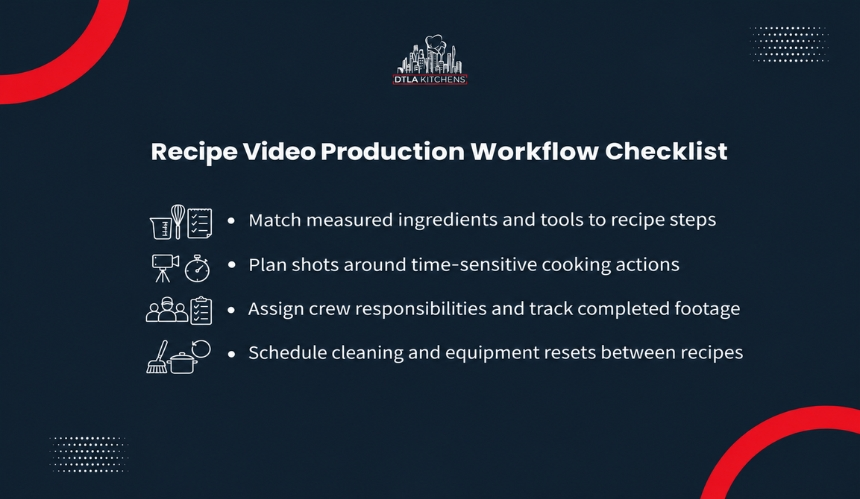
An efficient recipe video workflow coordinates culinary preparation with production timing so each stage is ready when the camera needs it. The goal is to reduce avoidable pauses, missed shots, and sequencing errors while keeping cooking progress aligned with the production plan.
Pre-Shoot Setup
Pre-production should translate the recipe into a practical filming sequence before active cooking begins. Ingredients should be measured, labeled, and arranged according to the order of use, while cookware, serving pieces, and specialty tools should be assigned to specific recipe steps. This creates a predictable handoff between preparation and recording.
The shot list should also be matched to the recipe timeline so the team knows which actions require wide shots, close-ups, overhead views, or repeated takes. Steps with limited timing windows, such as searing, melting, rising, or final garnishing, should be identified in advance because they offer fewer opportunities for retakes once the process begins.
During-Shoot Workflow
During filming, the production sequence should follow clearly defined responsibilities for the presenter, culinary support, camera operators, and production crew. Each person should know when to enter the working area, when to hold for recording, and when the recipe can advance to the next stage. Clear coordination prevents production activity from interrupting time-sensitive cooking steps.
The team should also track completed shots against the recipe sequence as filming progresses. Marking successful takes, pending close-ups, and required inserts reduces the risk of discovering missing footage after ingredients have changed state or the dish has already advanced beyond that step.
Cleanup and Reset Between Recipes
When multiple recipes are filmed in one session, the reset process should restore the production area to a known starting condition before the next recipe begins. Used cookware, leftover ingredients, spills, and packaging should be removed systematically so they do not carry visual or operational clutter into the following shoot.
|
A 2026 FDA study found that a full wash, rinse, sanitize, and air-dry process was effective at removing tested food allergens and minimizing transfer between food-contact surfaces. This becomes especially relevant when consecutive recipe shoots use different allergen profiles in the same kitchen studio. |
A structured reset also includes replenishing consumables, replacing used utensils, checking appliance readiness, and confirming that the next recipe’s ingredients are available. Treating cleanup as part of the production schedule rather than an afterthought reduces downtime and keeps multi-recipe shoots moving at a predictable pace.
Ready to film recipe content in a professional, production-ready space? DTLA Kitchens offers flexible kitchen solutions across Southern California, including kitchen studios, part-time and full-time kitchens, bakery kitchens, ice cream kitchens, and kosher kitchens. Choose the setup that fits your production needs and create with fewer workflow limitations.
Frequently Asked Questions
Book time for load-in, setup, test recordings, active cooking, resets, and load-out, not just the recipe’s cooking time. Batch shoots usually need more buffer because one delay can affect every planned dish. Some studios count setup and cleanup inside the rental period and charge overtime separately, so confirm the timing policy before booking.
Kitchen studio packages vary widely. Some rentals provide only the functional set, while others include lights, cookware, props, appliances, stands, or production support. Ask for an itemized inclusions list before the shoot. This prevents duplicate rentals and reveals whether specialty cookware, microphones, cameras, food styling tools, or crew services must be supplied separately.
The hourly or day rate may exclude cleaning, overtime, electricity, prop hire, large-crew surcharges, weekend access, waste disposal, parking, or security deposits. High-smoke cooking and fryer use can also trigger additional policies or charges. Request a complete rate sheet and calculate the expected total production cost before comparing kitchen studio options.
Insurance and permit requirements depend on the studio, production size, and local rules. Some facilities advise or require public liability coverage, while commercial productions may have separate permit obligations. Ask what documentation applies, whether studio coverage extends to renters, and whether outside crew, equipment, or branded commercial filming changes the requirements.
A professional camera does not determine whether a kitchen studio rental is worthwhile. A recent smartphone can produce strong recipe content when the production needs controlled conditions, repeatable sets, or multiple deliverables. Renting becomes more practical when a home kitchen limits consistency, batching efficiency, client presentation, or the visual standard expected for branded content.
Test recipes before the booked shoot whenever timing, texture, equipment behavior, or visual transformation could affect filming. Recipe testing reveals which steps need pre-made stages, duplicate portions, or tighter timing. It also prevents paid studio time from being consumed by correcting ingredient ratios, cooking temperatures, or techniques that should have been resolved during development.
One kitchen studio session can produce vertical and horizontal content efficiently, but compositions should be planned before filming. Keep critical actions within framing that can survive both 9:16 and 16:9 crops, or record dedicated angles for each format. This gives brands usable assets for Reels, TikTok, Shorts, websites, and long-form YouTube without awkward reframing.