
- DTLA Kitchens
What Equipment Should Bakers Look for in a Rental Kitchen?
Quick Answer
Bakers should look for a rental kitchen equipped with commercial ovens, planetary or spiral mixers, refrigeration units, stainless steel preparation tables, baking racks, and proper sanitation facilities. Equipment selection should match specific production requirements. Bread makers may need proofing cabinets and steam-capable ovens, while pastry producers may require dough sheeters and temperature-controlled storage.
Bakers should also evaluate oven capacity, mixer load limits, temperature accuracy, equipment condition, and workstation layout to prevent production bottlenecks. Before signing a rental agreement, confirm equipment availability during booked hours, storage arrangements, maintenance responsibilities, and additional usage fees. A suitable bakery rental kitchen should support consistent product quality, efficient batch production, food safety compliance, and predictable operating costs.
Choosing a rental kitchen requires more than confirming that commercial baking equipment is available. Bakers must assess whether the ovens, mixers, refrigeration, and preparation stations can handle their specific products and production volumes. Inadequate equipment capacity, inconsistent temperature control, or limited workspace can disrupt baking schedules, affect product quality, and increase operating costs.
A kitchen equipped for high-volume bread production may not meet the technical requirements of delicate pastries or decorated cakes. This blog explains what equipment bakers should look for in a rental kitchen and how to evaluate its suitability before making a commitment.
What Essential Baking Equipment Should a Rental Kitchen Have?
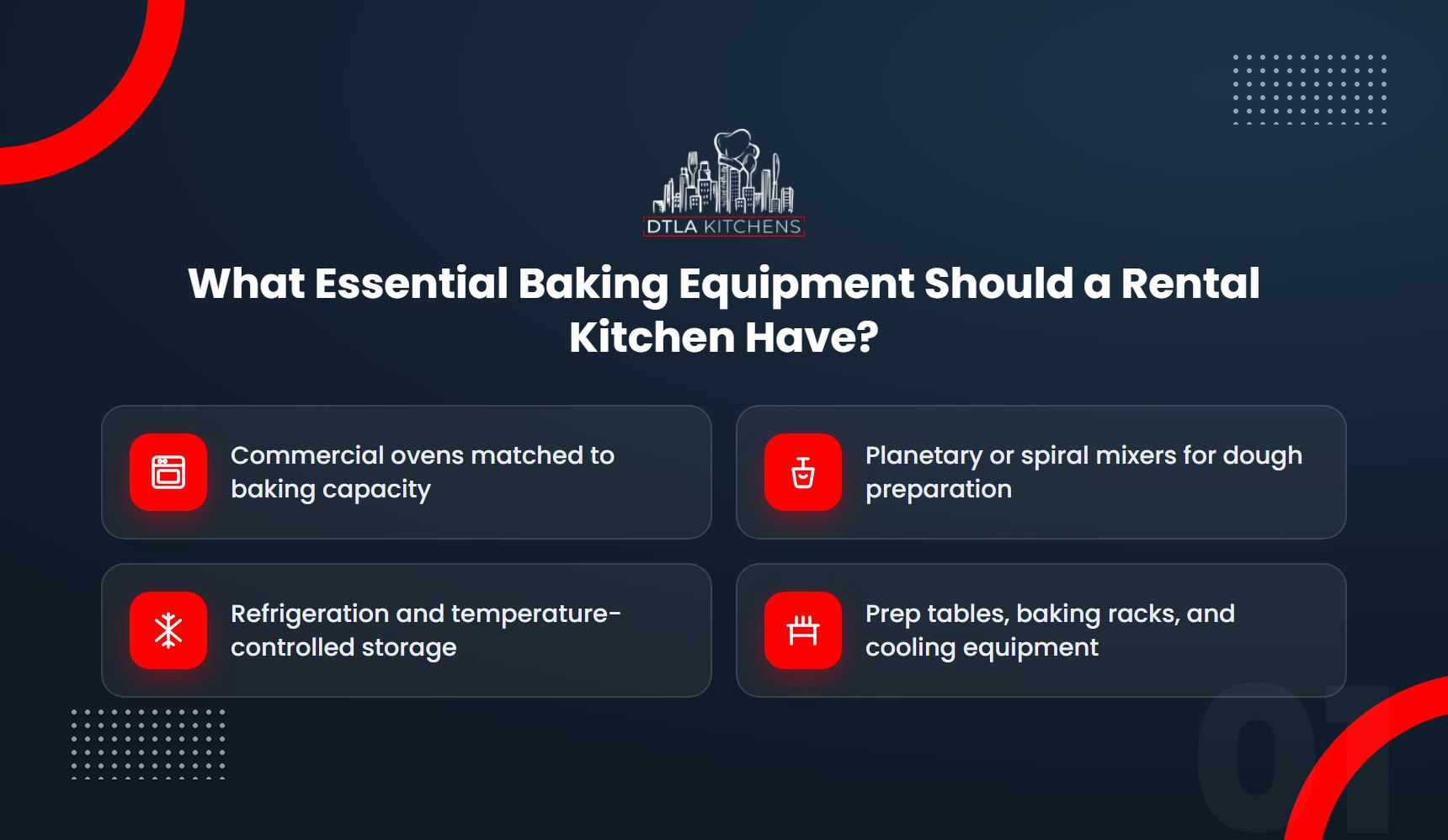
A bakery rental kitchen should provide commercial-grade equipment for mixing, preparing, baking, cooling, and storing products. The equipment must support the baker’s intended production methods while maintaining consistent processing conditions throughout each batch.
Bakers evaluating a bakery kitchen in Los Angeles, CA, should consider how commercial oven configurations, mixing equipment, refrigeration capacity, and preparation space align with their production requirements. Equipment suitability directly affects batch consistency, workflow efficiency, and the ability to fulfill orders within scheduled rental hours.
Commercial Ovens and Baking Capacity
Commercial ovens determine how efficiently baked goods receive and retain heat during production. Convection ovens circulate heated air through fans, making them suitable for cookies, cakes, and pastries requiring relatively uniform baking temperatures. Deck ovens use heated baking surfaces and controlled radiant heat, making them particularly suitable for artisan bread and products requiring strong bottom heat.
The U.S. Environmental Protection Agency’s ENERGY STAR program reports that certified commercial convection ovens are approximately 27% more energy efficient than standard models. Bakers comparing rental kitchens should consider oven efficiency when utility consumption is billed separately.
Bakers should examine oven chamber dimensions, rack configurations, temperature ranges, and the number of trays accommodated per cycle. Steam injection is another consideration for crusty bread, as moisture delays surface setting during the initial baking stage. The available oven configuration should match the product’s thermal requirements rather than simply offering a high maximum temperature.
Commercial Mixers and Dough Preparation Equipment
Commercial mixers must accommodate the consistency, hydration, and mechanical resistance of different bakery mixtures. Planetary mixers use interchangeable attachments, including paddles, whisks, and dough hooks, for cake batters, buttercream, cookie dough, and certain bread doughs. Spiral mixers rotate the bowl and spiral hook together, making them suitable for kneading larger quantities of yeast dough.
Mixer selection should account for usable bowl capacity, motor load limits, mixing speeds, and attachment availability. Dense, low-hydration dough places greater mechanical stress on the motor than lighter batters, so nominal bowl volume alone cannot establish suitability. Bakeries producing laminated pastries may also require dough sheeters to reduce dough thickness uniformly without excessive manual handling.
Refrigeration and Temperature-Controlled Storage
Commercial refrigeration preserves ingredient quality and supports controlled handling of temperature-sensitive bakery components. Reach-in refrigerators accommodate dairy products, eggs, prepared fillings, and refrigerated dough, while commercial freezers provide storage for frozen ingredients and products. Units should maintain temperatures appropriate to their contents, with accessible thermometers or digital monitoring systems.
Bakers should check whether refrigerated compartments offer sufficient shelf clearance for dough trays, ingredient containers, and finished products. Storage arrangements must also prevent cross-contact between allergens and contamination from raw ingredients. For operations involving butter-based pastry dough or cream-filled desserts, dependable refrigeration is necessary to maintain ingredient structure and safe holding conditions.
The FDA Food Code establishes 41°F (5°C) or below as the general cold-holding temperature for foods requiring time and temperature control for safety. Bakers handling cream fillings, custards, and other perishable ingredients should verify actual product temperatures rather than relying solely on refrigerator display settings.
Preparation Tables, Baking Racks, and Cooling Equipment
Food-grade preparation tables provide stable surfaces for scaling, dividing, shaping, and assembling bakery products. Stainless steel worktables are commonly used because their smooth, nonporous surfaces tolerate frequent cleaning and sanitizing. Bakers should check available counter dimensions, surface stability, and whether preparation areas accommodate equipment such as digital scales, cutting tools, and dough-handling accessories.
Baking racks, sheet pans, and cooling equipment support product handling after oven removal. Mobile speed racks accommodate multiple sheet pans while reducing repeated transfers between workstations. Wire cooling racks allow air to circulate around baked goods, limiting moisture accumulation beneath crusts and cookies. Adequate cooling space also prevents hot trays from obstructing active preparation surfaces during successive baking cycles.
Which Specialized Equipment Matters for Different Bakery Products?
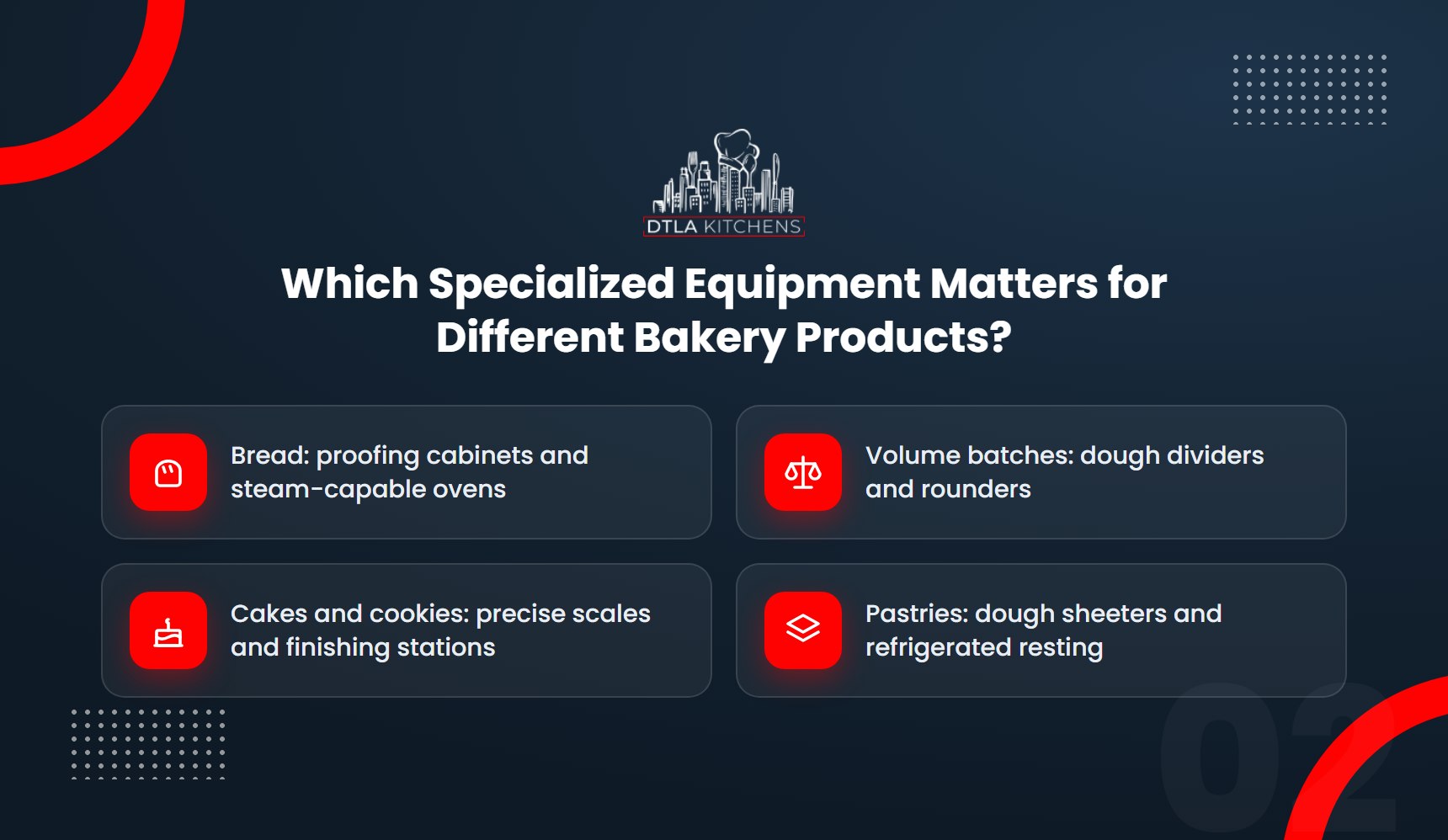
Specialized baking equipment should match the product’s preparation, fermentation, and finishing requirements. Bakers should prioritize machinery that directly supports their production methods.
Bread and Artisan Dough Production
Bread production often requires proofing cabinets that regulate temperature and humidity for controlled fermentation. Artisan bread may also require steam-capable ovens to delay crust formation and support oven spring. These features influence loaf volume, crust development, and consistency.
For larger batches, dough dividers and rounders maintain uniform portion weights and shaping. Bakers should determine whether manual dough handling is practical or whether production volume justifies automated equipment.
Cakes, Cookies, and Decorated Desserts
Cake and cookie production requires precise digital scales, portioning tools, and suitable finishing stations. Batter dispensers and cookie scoops maintain consistent product weights, while cake turntables support controlled frosting application and detailed decoration.
Temperature-sensitive finishes, including buttercream, ganache, and chocolate, require suitable working conditions. Excessive ambient heat can soften coatings, distort piping, and compromise decorative structures.
Pastries, Croissants, and Laminated Dough
Laminated pastries require dough sheeters with adjustable rollers to maintain uniform thickness during repeated folding. Consistent rolling preserves alternating butter and dough layers, which are essential for flaky pastry structure.
Croissants and puff pastry also require refrigerated resting between folds. Controlled chilling prevents butter from softening excessively and allows gluten relaxation, reducing dough shrinkage and layer damage during shaping.
How Can Bakers Evaluate Equipment Capacity and Performance?
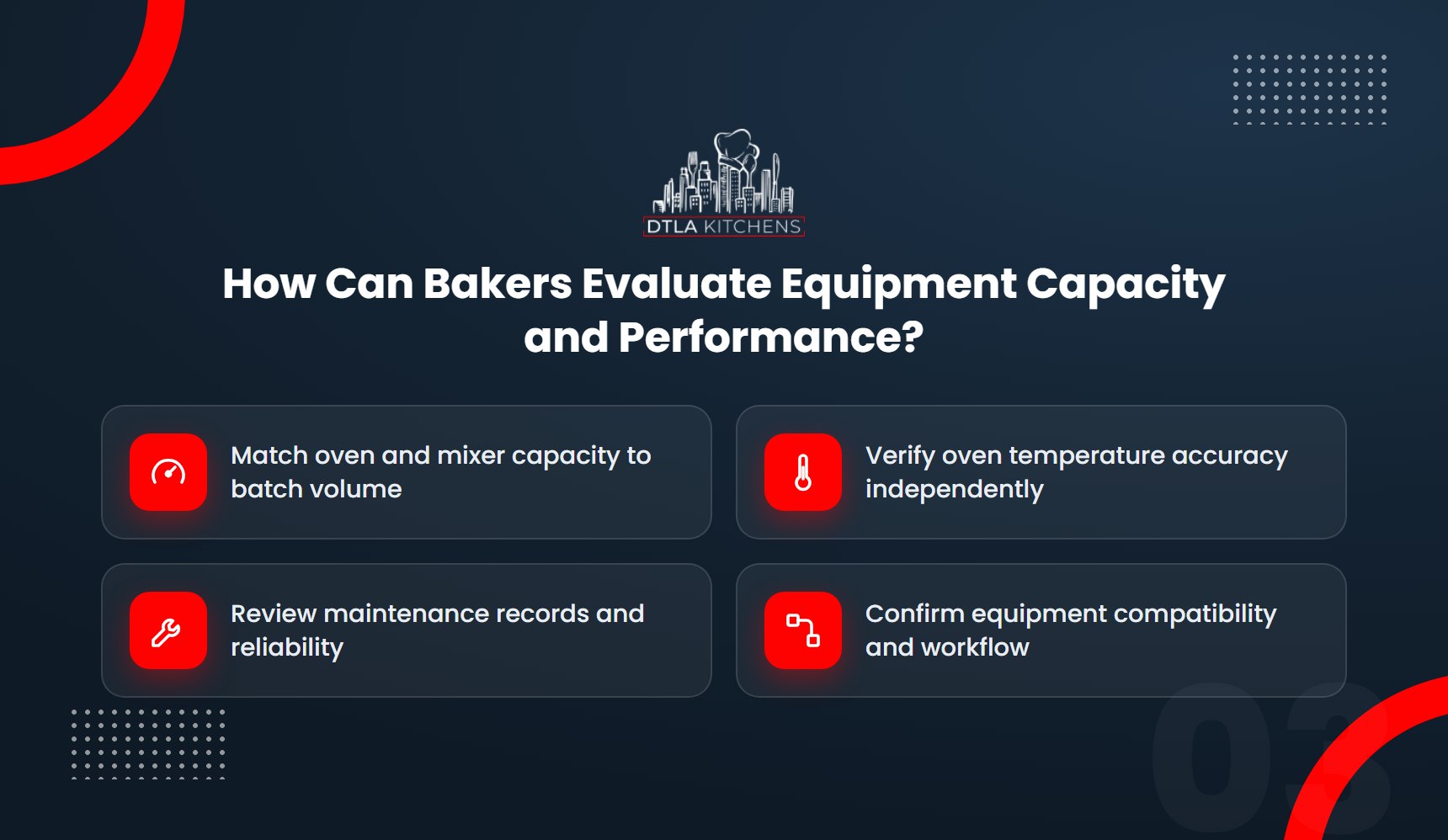
Bakers should assess whether rental kitchen equipment can meet production targets without causing delays or inconsistent results. Capacity, mechanical condition, and workstation compatibility determine how efficiently equipment performs during scheduled kitchen hours.
Match Equipment Capacity to Production Volume
Equipment capacity should align with planned batch quantities and production frequency. Bakers can estimate oven throughput by multiplying the number of trays per cycle by the number of baking cycles possible within their rental period. Preheating, loading, and unloading time must also be considered.
Mixer capacity should reflect actual dough weight rather than bowl volume alone. When mixing or baking equipment cannot process the required quantities efficiently, additional production cycles increase labor hours and rental expenses.
Check Equipment Condition and Operational Reliability
Equipment condition directly affects product consistency and production interruptions. Bakers should verify oven temperature accuracy using an independent thermometer and check whether heating elements distribute heat evenly. Mixers should operate smoothly without unusual vibrations, excessive noise, or inconsistent speed control.
Maintenance records can reveal recurring mechanical problems and servicing frequency. Refrigeration units should maintain stable operating temperatures, while equipment inspection should identify damaged seals, worn attachments, or malfunctioning controls before rental commitments.
Evaluate Equipment Compatibility and Workflow
Equipment compatibility determines whether baking tools and workstations function together without unnecessary adjustments. Bakers should confirm that sheet pans fit oven rails, mixer attachments match installed machines, and mobile racks can move safely between preparation and baking areas.
Workstation layout should allow uninterrupted movement between production stages. Adequate electrical connections, equipment clearance, and accessible preparation surfaces reduce handling delays and prevent congestion during simultaneous baking activities.
What Storage, Sanitation, and Safety Equipment Should Be Available?
A rental kitchen must provide suitable storage, sanitation, and safety facilities to support hygienic bakery operations. These systems protect ingredients from contamination, maintain organized production areas, and reduce operational hazards.
Ingredient and Finished-Product Storage
Dry storage areas should include food-grade shelving, sealed containers, and designated spaces for ingredients and packaging materials. Shelving should keep supplies off the floor and protect them from moisture, pests, and accidental contamination.
Shared kitchens should provide clearly assigned storage areas with appropriate labeling. Separate handling and storage arrangements for allergenic ingredients, raw materials, and finished products reduce cross-contact risks.
Cleaning and Food Safety Facilities
Commercial rental kitchens should provide dedicated sanitation facilities to prevent cross-contamination and maintain hygienic baking conditions. Bakers should verify the availability of:
- Handwashing sinks: Conveniently located stations with soap and disposable towels.
- Three-compartment sinks: Separate sections for washing, rinsing, and sanitizing baking utensils.
- Commercial dishwashers: Equipment capable of meeting required sanitization standards.
- Food-safe sanitizers: Approved cleaning agents suitable for food-contact surfaces.
- Sanitizer test strips: Tools for verifying appropriate chemical sanitizer concentrations.
- Waste disposal stations: Covered containers and designated areas for handling food waste.
Cleaning facilities should accommodate the kitchen’s production activities without interfering with food preparation. Bakers should also confirm sanitation responsibilities and whether cleaning supplies are included in the rental agreement.
The FDA’s 2022 Food Code specifies cleaning food-contact surfaces used with time/temperature control for safety foods at least every four hours during continuous use, unless an exception applies. This makes accessible washing and sanitizing stations particularly relevant during extended bakery production sessions.
Ventilation and Fire Safety Equipment
Ventilation systems must accommodate heat, moisture, and emissions generated by commercial baking appliances. Depending on equipment type and local fire codes, kitchens may require mechanical exhaust systems, appropriate hoods, and fire suppression equipment.
Fire extinguishers, unobstructed emergency exits, and safe clearances around heated equipment are essential safety considerations. Bakers should verify that installed appliances and fire protection systems meet applicable building, health, and fire safety requirements.
OSHA identifies flour, sugar, and starch among food materials capable of producing combustible dust hazards when fine particles become airborne under certain conditions. Bakeries handling substantial quantities of dry ingredients should assess dust accumulation, housekeeping procedures, and appropriate dust-control measures alongside conventional fire protection.
What Should Bakers Check Before Renting a Kitchen?
Before signing a rental agreement, bakers should verify equipment availability, usage restrictions, and additional costs. An on-site inspection can reveal limitations that equipment listings or kitchen photographs may not show.
Essential Rental Kitchen Equipment Checklist:
- Included equipment: Confirm which ovens, mixers, refrigeration units, and preparation tools are covered by the rental fee.
- Equipment access: Determine whether appliances are exclusively available during booked hours or shared with other tenants.
- Specialized machinery: Check whether proofers, dough sheeters, and decorating equipment require separate reservations or fees.
- Operational testing: Request a demonstration to verify that essential equipment functions as expected.
- Personal equipment: Confirm whether outside appliances and baking tools are permitted.
- Storage arrangements: Review allocated storage space, access restrictions, and associated charges.
- Maintenance responsibilities: Clarify who handles equipment breakdowns, repairs, and replacement arrangements.
- Rental scheduling: Verify whether equipment setup, preheating, production, and cleaning must occur within reserved hours.
- Additional charges: Identify fees for utilities, storage, cleaning, or equipment usage.
Bakers should compare the total rental cost against usable equipment access and expected production output rather than selecting a kitchen solely based on its advertised equipment inventory. A kitchen that meets actual production requirements can reduce scheduling conflicts, unnecessary expenses, and operational interruptions.
The right baking equipment can make the difference between smooth production and costly delays. DTLA Kitchens offers flexible Bakery Kitchen rentals for bakers across the Greater Los Angeles area, with options for growing businesses and established bakery operations. Whether production requires occasional access or a dedicated workspace, flexible Part-Time Kitchen and Full-Time Kitchen rentals accommodate different schedules and production demands. Contact DTLA Kitchens today to explore a baking workspace that fits your equipment needs and production goals.
Frequently Asked Questions
Many commercial kitchen rentals provide shared access to major appliances, allowing bakers to operate without purchasing expensive machinery. However, smaller tools such as piping bags, specialty molds, measuring instruments, and baking pans may not be included. Reviewing the kitchen's inventory helps determine which supplies must be purchased or transported separately.
Shared commercial kitchens can accommodate growing home bakeries that need additional production space or access to commercial appliances. Bakers should evaluate minimum booking hours, recurring rental costs, and storage availability. Comparing expected order volume against hourly kitchen expenses helps determine whether transitioning from home-based production is financially practical.
Shared equipment requires documented cleaning procedures, scheduled access, and controls for allergen cross-contact. Residues from wheat, milk, eggs, nuts, or sesame can remain on utensils and machinery without effective cleaning. Bakers producing allergen-sensitive products should verify cleaning protocols and determine whether dedicated equipment is necessary.
Equipment failures can interrupt production, spoil temperature-sensitive ingredients, and delay customer orders. Rental agreements should specify repair responsibilities, alternative equipment availability, and policies for interrupted bookings. Bakers should also determine whether unused rental hours qualify for credits or refunds when essential appliances become unavailable through no fault of their own.
A licensed rental facility does not automatically authorize every tenant's food business. Depending on local regulations, bakers may need separate food business permits, food handler certifications, or product-specific approvals. Requirements can also differ for wholesale distribution and direct-to-consumer sales. Confirming obligations with the relevant health department prevents compliance problems.
Hourly rentals generally suit occasional orders, seasonal baking, and businesses with unpredictable production schedules. Monthly arrangements may offer better cost efficiency for frequent production, particularly when storage and equipment access are included. Bakers should calculate their effective hourly cost, including minimum bookings, recurring fees, and unused reserved time.
Wholesale baking may require additional regulatory approvals, traceability records, product labeling, and suitable packaging facilities. Requirements depend on the products, distribution channels, and jurisdiction. Bakers supplying cafés, grocery stores, or restaurants should confirm whether the kitchen permits wholesale operations and supports the documentation and handling procedures required for commercial distribution.