
- DTLA Kitchens
Commercial Bakery Kitchen Checklist for Bakers
Key Takeaways
|
A commercial bakery kitchen requires more than functional ovens and mixing equipment. Poor workstation organization, improper ingredient storage, inconsistent sanitation, and overlooked equipment checks can disrupt production, compromise food safety, and increase operating costs. Bakers must verify that every preparation area, storage system, and production process meets operational requirements before handling commercial batches.
A structured commercial bakery kitchen checklist helps identify readiness gaps, maintain consistent baking conditions, and reduce preventable downtime. This guide covers the essential equipment, storage, sanitation, and daily operational checks needed for an efficient commercial bakery kitchen.
What Should a Commercial Bakery Kitchen Checklist Include?
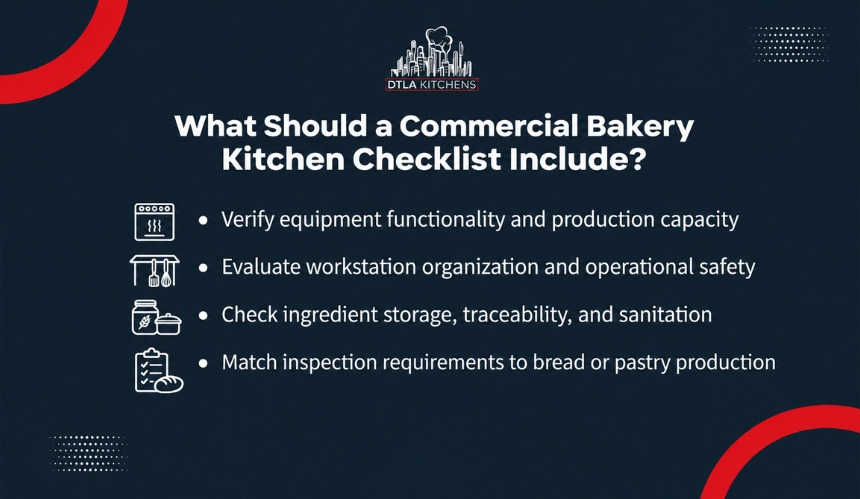
A commercial bakery kitchen checklist should cover five essential areas: equipment readiness, workstation organization, ingredient management, sanitation, and operational safety. Each category requires specific inspection points to confirm that the kitchen can handle scheduled production without avoidable interruptions or food safety violations.
A complete checklist should distinguish between equipment availability and operational readiness. For example, an installed commercial oven does not guarantee production capacity unless its heating elements, temperature controls, and baking chambers function correctly. Similarly, adequate ingredient inventory becomes ineffective when storage conditions compromise ingredient stability or traceability.
Essential Commercial Bakery Kitchen Checklist
Checklist Category | What Bakers Should Verify |
Equipment Readiness | Ovens, mixers, proofers, refrigeration units, and measuring instruments function within required operating parameters. |
Workstation Organization | Preparation surfaces, production zones, and equipment access support uninterrupted movement between baking tasks. |
Ingredient Management | Ingredients have accurate identification, suitable storage conditions, and sufficient quantities for scheduled batches. |
Food Safety and Sanitation | Food-contact surfaces are sanitized, handwashing facilities are accessible, and contamination controls are established. |
Operational Safety | Equipment guards, ventilation, emergency access routes, and electrical connections are in safe working condition. |
The checklist should also reflect the bakery’s production type. Bread production requires particular attention to dough handling, fermentation conditions, and proofing capacity, while pastry operations may depend more heavily on temperature-controlled preparation surfaces and refrigerated ingredient handling. These differences determine which inspection points require greater attention during kitchen preparation.
Key Note: A bakery kitchen should be evaluated against its actual production requirements rather than equipment availability alone. A mixer that operates correctly may still create a production bottleneck if its batch capacity cannot support the daily baking schedule.
Essential Commercial Bakery Equipment and Workstation Checklist
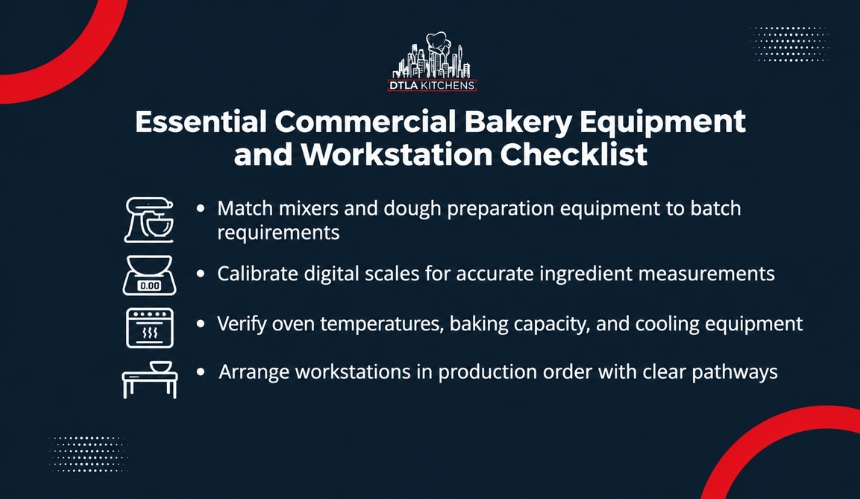
Commercial bakery equipment must match production volume, recipe requirements, and available kitchen space. Equipment selection should account for batch capacity, processing speed, temperature consistency, and workstation accessibility to prevent production bottlenecks.
Commercial bakers evaluating a bakery kitchen in Los Angeles should assess equipment capacity, workstation layout, ventilation requirements, and available preparation space to ensure the facility supports planned production volumes and local health and safety requirements.
Mixing, Measuring, and Dough Preparation Equipment
Commercial mixers should accommodate the maximum dough weight specified by the manufacturer, including restrictions for dense or low-hydration dough. Planetary mixers handle batters, creams, and lighter dough formulations, while spiral mixers provide controlled kneading for larger bread batches. Overloading a mixer increases motor strain and can produce inconsistent gluten development.
Digital scales require calibration checks to maintain accurate ingredient ratios, particularly for yeast, salt, and chemical leavening agents. Dough sheeters, dividers, and preparation tables should match the bakery’s product range and batch sizes. Equipment with adjustable processing settings allows bakers to maintain consistent dough thickness, portion weights, and handling characteristics.
Baking, Cooling, and Finishing Equipment
Commercial ovens should deliver stable baking temperatures and sufficient chamber capacity for scheduled production. Convection ovens circulate heated air for more uniform heat transfer, while deck ovens provide conductive heat through baking surfaces. Bakers should verify thermostat accuracy, door seals, heating performance, and recovery time between batches because temperature fluctuations can affect crust formation, moisture loss, and internal product structure.
The FDA’s 2022 Food Code specifies that cooked foods requiring time-temperature control for safety must cool from 135°F to 70°F within two hours and reach 41°F or below within six hours total. Bakeries handling applicable cooked fillings or custards must account for these limits when planning cooling capacity. |
Cooling racks must provide adequate spacing for heat and moisture to escape before packaging or decorating. Insufficient cooling capacity can create condensation inside packaging, affecting crust texture and product quality. Finishing stations should accommodate decorating equipment, portioning tools, and packaging materials without exposing completed products to unnecessary handling.
Kitchen Layout and Workstation Readiness
A commercial bakery kitchen should follow a logical production sequence from ingredient preparation through mixing, shaping, baking, cooling, and packaging. Workstations arranged in processing order reduce unnecessary movement, prevent congestion around shared equipment, and limit repeated handling of unfinished products. Preparation tables should provide sufficient clearance for mixing bowls, baking trays, and mobile ingredient containers.
Equipment placement must also account for manufacturer-specified ventilation clearances, maintenance access, and safe movement around heated surfaces. Heavy mixers require stable installation, while ovens and proofers need appropriate utility connections and accessible controls. Clear pathways between production zones allow staff to transport loaded trays and dough containers without obstructing other baking operations.
Quick Tip: Before finalizing a bakery kitchen layout, compare the expected hourly output of mixers, proofers, and ovens. When one machine processes fewer batches than the preceding stage, unfinished products accumulate and create a production bottleneck.
Ingredient Storage and Food Safety Checklist for Commercial Bakers
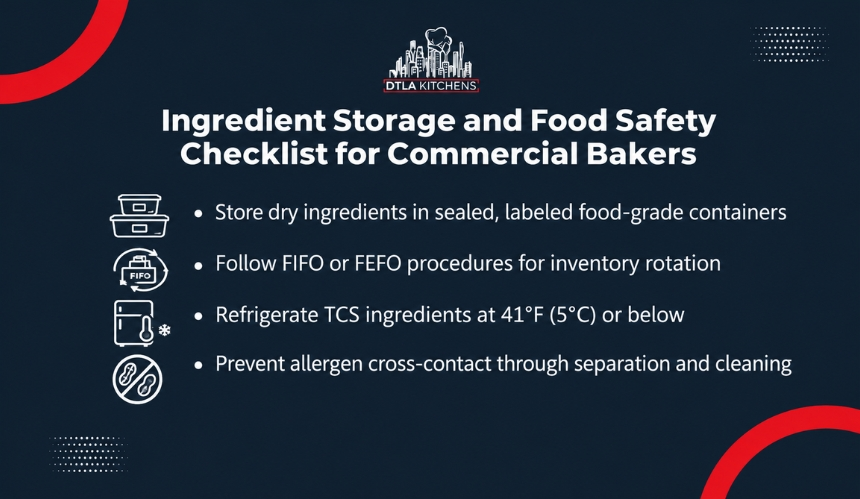
Commercial bakery ingredient storage requires controlled environmental conditions, accurate inventory records, and separation of contamination risks. Flour, yeast, dairy products, eggs, and prepared fillings have different storage requirements that directly influence ingredient stability, microbial growth, and finished-product consistency.
Dry Ingredient Storage and Inventory Checks
Dry ingredients require protection from moisture, pests, temperature fluctuations, and external contaminants. Flour, sugar, baking powder, and dried yeast should remain in food-grade, tightly sealed containers with clearly identified product names, lot numbers, and expiration or best-before dates. Flour exposed to excessive humidity can develop clumps and support mold growth, while improperly stored leavening agents may lose effectiveness and produce inconsistent dough expansion.
Inventory checks should follow first-in, first-out (FIFO) or first-expired, first-out (FEFO) procedures, depending on product dating and shelf-life requirements. Bakers should inspect packaging integrity, record incoming ingredient quantities, and maintain traceability to supplier batches. Storage shelving should keep ingredients off the floor and allow sufficient access for inspection, cleaning, and pest monitoring.
Refrigerated and Frozen Ingredient Storage
Temperature-sensitive ingredients such as milk, cream, eggs, butter, and prepared custard fillings require storage conditions appropriate to their food safety risks and manufacturer specifications. Refrigerated storage for time/temperature control for safety (TCS) foods generally requires temperatures of 41°F (5°C) or below under the FDA Food Code, while frozen ingredients should remain frozen at appropriate storage temperatures. Temperature records help identify refrigeration failures before ingredient safety becomes compromised.
The FDA’s 2022 Food Code establishes a maximum seven-day refrigerated holding period at 41°F or below for applicable ready-to-eat, time-temperature-controlled foods held longer than 24 hours. Prepared bakery fillings that fall under these requirements need date markings that identify when they must be consumed or discarded. |
Refrigerators should contain sufficient space for air circulation, with raw ingredients positioned to prevent contamination of ready-to-eat products. Frozen ingredients requiring thawing should generally be defrosted under refrigeration or through another approved method rather than left at room temperature. Bakers must also distinguish between ingredients that require strict temperature control and products that can safely tolerate limited temperature exposure during preparation.
Allergen Management and Cross-Contact Prevention
Commercial bakeries frequently handle major food allergens, including wheat, milk, eggs, soy, peanuts, tree nuts, and sesame. Shared mixers, preparation tables, utensils, and ingredient containers can transfer allergenic proteins between recipes. Even small residues may create a safety risk for consumers with food allergies, making allergen identification and controlled ingredient handling essential parts of bakery food safety procedures.
Allergen management should begin with verified supplier specifications and accurate recipe records. Where practical, bakeries should use dedicated utensils, separate ingredient storage, and defined production sequences for products with different allergen profiles. Cleaning procedures must effectively remove allergen residues, and packaged products should carry accurate ingredient and allergen declarations consistent with applicable labeling regulations.
The FDA’s FASTER Act requirements made sesame the ninth major food allergen in the United States on January 1, 2023. Commercial bakeries using sesame seeds, tahini, or sesame-containing ingredients must account for this requirement when preparing allergen declarations on applicable packaged products. |
Commercial Bakery Cleaning, Sanitation, and Safety Checklist
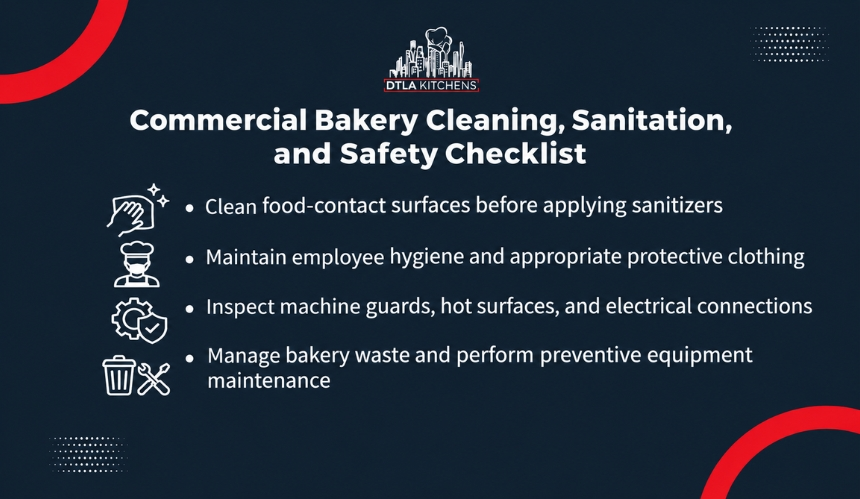
Commercial bakery sanitation requires consistent cleaning procedures, employee hygiene controls, and workplace hazard inspections. Flour dust, grease, dough residues, and moisture accumulation can increase contamination risks and create unsafe production conditions.
Food-Contact Surface Cleaning and Sanitization
Food-contact surfaces must be cleaned before sanitization because residual flour, fats, and proteins can reduce sanitizer effectiveness. Mixing bowls, dough hooks, preparation tables, and baking trays require cleaning procedures suited to their materials and contamination levels.
Commercial bakery cleaning procedures should include:
- Surface cleaning: Remove food residues using suitable detergents and cleaning tools.
- Sanitizer verification: Follow approved chemical concentrations and contact times.
- Equipment sanitation: Clean shared utensils and machinery between applicable production activities.
- Cleaning records: Document completed tasks, inspection findings, and corrective actions.
Employee Hygiene and Kitchen Safety
Bakery employees must follow handwashing procedures, wear appropriate protective clothing, and report symptoms associated with foodborne illness. Handwashing stations should remain accessible and adequately supplied. Poor hygiene practices can transfer contaminants from employees to exposed ingredients and finished bakery products.
Workplace safety inspections should address rotating mixer components, hot oven surfaces, electrical connections, and manual lifting hazards. Machine guards must remain secured during operation, while suitable thermal protection reduces burn risks. Emergency exits and fire protection equipment should remain accessible throughout production.
Waste Management and Preventive Maintenance
Bakery waste containers should be cleanable, appropriately covered, and emptied frequently enough to prevent pest attraction. Flour spills, discarded dough, and packaging debris require prompt removal to reduce slipping hazards and contamination risks.
OSHA’s bakery equipment standard, 29 CFR 1910.263, includes specific safeguards for commercial mixers, including requirements addressing moving components and bowl-locking mechanisms. The standard also requires suitable devices for moving vertical mixer bowls weighing more than 80 pounds with their contents into and out of the mixing position. |
Preventive maintenance should cover refrigerator door gaskets, oven seals, plumbing connections, and ventilation components. Damaged parts can compromise temperature control, sanitation, and equipment reliability. Maintenance records should identify inspection findings, required repairs, and completed corrective actions.
Did You Know? OSHA identifies flour as a combustible dust that can contribute to fires or explosions under certain conditions. Commercial bakeries should control airborne flour particles and avoid cleaning practices that disperse accumulated dust near potential ignition sources.
Daily Commercial Bakery Opening and Closing Checklist
Daily bakery operations require scheduled inspections before production, monitoring during baking, and documented shutdown procedures. A structured routine helps bakers detect process deviations, maintain batch consistency, and prevent unresolved issues from affecting subsequent shifts.
Pre-Production Kitchen Opening Checks
Opening checks should confirm that the kitchen can meet the day’s production schedule. Shift supervisors should review pending maintenance reports, verify ingredient quantities against planned recipes, and confirm that required equipment has reached its operating conditions.
Bakers should also review batch sheets, employee assignments, and any unfinished corrective actions from the previous shift. Production should begin only after critical issues affecting food safety or equipment operation have been resolved.
Production Monitoring and Quality Control Checks
Production monitoring should focus on measurable parameters that affect finished bakery products. Bakers should record mixing duration, dough temperature, fermentation time, proofing conditions, and oven settings where relevant to the recipe. Deviations can affect gluten development, product volume, crumb structure, and baking consistency.
Batch identification records should connect production times, recipes, and finished product quantities. When quality defects occur, these records help determine whether the cause originated during mixing, fermentation, baking, or handling, reducing unnecessary adjustments to unaffected batches.
End-of-Day Cleaning and Kitchen Shutdown
Closing procedures should confirm that production areas are ready for the next operating period. Remaining ingredients and unfinished products must be correctly labeled, stored, or discarded based on their condition and approved holding requirements.
Shift supervisors should verify cleaning completion, reconcile production records, and document equipment faults requiring attention. Nonessential machinery should be shut down according to manufacturer instructions, while refrigeration and other systems requiring continuous operation must remain active.
Quick Tip: Use a shift handover log to record unresolved equipment faults, ingredient shortages, and incomplete production tasks. Assigning each issue to a responsible employee prevents operational problems from carrying into the next shift without corrective action.
A well-equipped bakery kitchen should support consistent production without costly equipment limitations or workspace bottlenecks. DTLA Kitchens offers flexible bakery kitchen and shared kitchen rental options for bakers across the Greater Los Angeles area and Orange County. Whether scaling daily batches, testing new recipes, or expanding commercial operations, bakers can explore part-time, full-time, and long-term kitchen rental solutions that match their production needs. Explore DTLA Kitchens’ rental options and find a workspace that fits your baking operations.
Frequently Asked Questions
Commercial bakeries typically require business registration, applicable food establishment permits, and approval from local health or food safety authorities. Depending on the jurisdiction, building occupancy, fire safety, and zoning approvals may also apply. Operators should confirm requirements before purchasing equipment or renovating a facility because residential and commercial food production regulations often differ.
A separate proofing room is not always necessary if the bakery can maintain suitable fermentation conditions using proofing cabinets or other controlled environments. Production volume, dough type, humidity, and temperature stability determine the appropriate setup. High-volume bread operations may benefit from dedicated proofing space to prevent fermentation delays and inconsistent product development.
Required kitchen space depends on equipment dimensions, production volume, workflow, and local building regulations. A compact bakery producing limited batches may operate with less space than a wholesale facility using multiple ovens and dough-processing machines. Operators should calculate equipment footprints, service clearances, storage capacity, and safe movement routes before selecting premises.
A commercial bakery kitchen is designed or equipped for baking operations, while a commissary kitchen is a licensed shared or dedicated food production facility that businesses may rent. Commissary facilities can reduce initial infrastructure costs, but shared equipment schedules, storage limitations, and restricted operating hours may affect bakery production capacity.
Gluten-free production requires controls beyond standard ingredient separation because airborne flour and shared processing equipment can introduce gluten residues. Dedicated preparation areas, validated cleaning procedures, and appropriate ingredient verification reduce cross-contact risks. Bakeries making gluten-free labeling claims must also meet applicable regulatory standards, including the FDA's less-than-20-parts-per-million requirement for qualifying foods in the United States.
Official health inspection frequency varies by jurisdiction, facility risk classification, compliance history, and food processing activities. Some establishments receive routine inspections more frequently than others, particularly when handling higher-risk foods. Bakery operators should distinguish mandatory regulatory inspections from internal food safety audits and consult their local authority for applicable inspection schedules.
Equipment failure requires an immediate assessment of product safety, processing stage, and available alternatives. Temperature-sensitive ingredients or partially processed products may need controlled holding or disposal when safe conditions cannot be maintained. Operators should document affected batches, evaluate time-temperature exposure, and resume production only after equipment functionality and product safety are verified.