
- dtlta-Kitchens
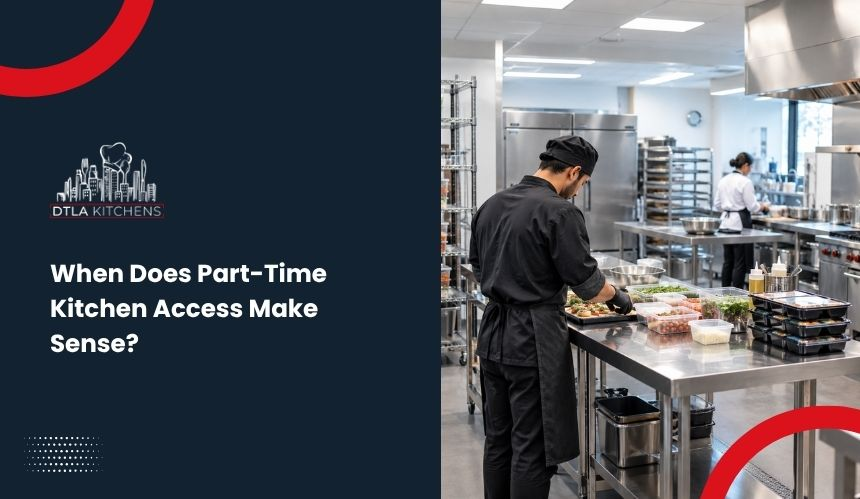
When Does Part-Time Kitchen Access Make Sense?
Key Takeaways: Part-time kitchen access makes sense for food businesses that need a professional kitchen regularly but don’t need a dedicated space every day. It allows operators to schedule kitchen time around actual production needs instead of taking on the cost and commitment of maintaining a full-time commercial kitchen. Part-time access may be a practical fit for:
For these operators, DLTA Kitchens can provide access that better matches production frequency, allowing businesses to use commercial kitchen space when needed rather than paying for capacity that may sit unused. Important: Part-time kitchen access works best when production can be planned into defined time blocks. Businesses requiring continuous preparation, extensive storage, or daily unrestricted kitchen use may eventually need a different access arrangement. |
Not every food business needs a commercial kitchen seven days a week. Caterers may prepare food around booked events, bakers may work in scheduled production batches, and food vendors may only need kitchen space before markets or service days. For these businesses, paying for full-time kitchen access can mean taking on space and costs that do not match how often production actually occurs.
Part-time kitchen access offers a more flexible alternative by allowing food businesses to schedule professional kitchen time around their production needs. Instead of committing to a dedicated facility before the business requires one, operators can use kitchen space during planned preparation and production periods.
The key is determining whether the business can operate effectively within scheduled kitchen blocks. Production volume, frequency, storage requirements, preparation time, and future growth all influence whether part-time access remains practical or whether the business needs more consistent kitchen availability.
When Is Part-Time Kitchen Access a Good Fit?
Part-time kitchen access is most useful when a food business has predictable production needs that can be organized into scheduled blocks. Rather than requiring permanent kitchen availability, the operator can reserve enough time to complete preparation, cooking, baking, packaging, and cleanup according to the business’s actual production schedule.
When Does a Scheduled Production Model Work Well?
Businesses that already know when they need to produce are often well suited to part-time kitchen access. A baker might schedule production before order pickup days, while a caterer may reserve kitchen time around confirmed events. Predictable production makes it easier to estimate the kitchen hours required for each production cycle.
Can Batch Production Make Part-Time Kitchen Access More Practical?
Yes. Food businesses that can consolidate preparation into larger production batches may not need kitchen access every day. Ingredients can be prepared, products produced, and orders packaged during planned sessions, provided the available kitchen time and storage arrangements support the complete workflow.
Does Part-Time Kitchen Access Work for Businesses With Fluctuating Demand?
It can. Caterers, pop-up operators, market vendors, and other businesses may have production schedules that change according to orders or events. Part-time access can accommodate these variations when kitchen time can be reserved around expected demand rather than requiring continuous access throughout the week.
Is Part-Time Kitchen Access Useful Before Committing to More Space?
For a growing food business, part-time access can provide an intermediate step before taking on a dedicated kitchen. Operators can track how much kitchen time they actually use, understand their production capacity, and identify workflow limitations before deciding whether increased or full-time access makes operational sense.
Did You Know?
Cooking hours are only part of the calculation. Setup, ingredient preparation, cooking or baking, cooling, packaging, cleanup, and storage coordination can all affect how much kitchen time a business actually needs.
Which Food Businesses Can Benefit From Part-Time Kitchen Access?
Part-time kitchen access can suit food businesses whose production happens on specific days, around confirmed orders, or in planned batches. The best fit is usually an operation that needs a professional production environment but can complete its kitchen-based work without continuous daily access.
When Does Part-Time Kitchen Access Make Sense for Caterers?
Caterers often prepare around scheduled events rather than producing at the same volume every day. Part-time access lets you plan kitchen time around confirmed bookings, preparation needs, and event dates. As bookings increase, operators can reassess whether their reserved kitchen hours still provide enough production capacity.
Can Bakers Use a Commercial Kitchen on a Part-Time Basis?
Bakers with scheduled order, wholesale, or pickup days may be able to consolidate mixing, baking, cooling, and packaging into defined production sessions. This arrangement is most practical when the reserved time provides enough capacity for the entire workflow and any storage requirements can be coordinated appropriately.
How Can Meal-Prep Businesses Use Scheduled Kitchen Time?
Meal-prep businesses often follow recurring production cycles, making scheduled kitchen access potentially suitable for their workflow. They can prepare ingredients, cook meals, assemble portions, and package orders during planned sessions. The required access depends heavily on order volume and how long each production cycle takes to complete.
Why Can Part-Time Access Work for Food Trucks and Mobile Vendors?
Food trucks and mobile vendors may need a kitchen for preparation, ingredient handling, storage coordination, or other commissary-related tasks without needing to produce there continuously. Scheduled access can work when kitchen use aligns with service days and the operator has enough time to complete required preparation before leaving for service.
Can Pop-Ups and Market Vendors Benefit From Part-Time Access?
Pop-up and market vendors often produce around specific selling dates rather than maintaining daily production. Reserving kitchen time before markets or events can match this operating model well, especially when production quantities are predictable enough to complete within scheduled sessions.
Important:
Business type alone does not determine whether part-time kitchen access is appropriate. Consider production frequency, batch size, preparation time, equipment needs, storage, cleanup, and order volume before deciding how much kitchen access an operation actually requires.
How Do You Know Whether Part-Time Kitchen Access Is Enough?
Part-time access only remains practical when the available kitchen hours can support the complete production workflow. Food businesses should look beyond how many days they cook and consider preparation time, production volume, equipment use, packaging, cleanup, and storage. These factors help determine whether scheduled access provides enough capacity.
How Many Kitchen Hours Does Production Actually Require?
Operators should estimate the full time required from setup through cleanup rather than counting cooking or baking time alone. Ingredient preparation, equipment setup, cooling, portioning, packaging, dishwashing, and sanitation can extend a production session considerably. Tracking actual kitchen hours can provide a more realistic basis for scheduling access.
Can Your Production Volume Fit Into Reserved Kitchen Time?
Part-time access becomes less practical when order volume consistently exceeds what can be produced during reserved sessions. Businesses should consider how many batches, meals, baked goods, or other products can realistically be completed within each booking without creating an overly compressed workflow.
Do Your Equipment Needs Match the Available Kitchen Setup?
Production efficiency depends partly on whether the necessary equipment is available when the business is scheduled to work. Oven capacity, burners, preparation surfaces, sinks, refrigeration, and other required equipment can influence how much can be produced during a session. Limited access to essential equipment may increase the kitchen hours needed.
How Do Storage Needs Affect Part-Time Kitchen Access?
Storage can become an important consideration when ingredients, prepared products, packaging, or finished orders need to remain at the facility between production sessions. Businesses should assess available storage and whether it supports their workflow before assuming scheduled kitchen hours alone will meet their operational needs.
When Can Part-Time Access Start Feeling Too Limited?
A business may begin outgrowing part-time access when production sessions regularly run short, additional kitchen days are repeatedly needed, or increasing order volume becomes difficult to accommodate. At that point, comparing the cost and operational benefits of greater kitchen access can help you decide on the next step.
Important:
The best indicator is not simply how often the kitchen is booked, but whether the business can complete production comfortably within those scheduled periods. Repeatedly adding hours or struggling to fit orders into available sessions may indicate that the operation needs more consistent access.
What Are the Cost Advantages of Part-Time Kitchen Access?
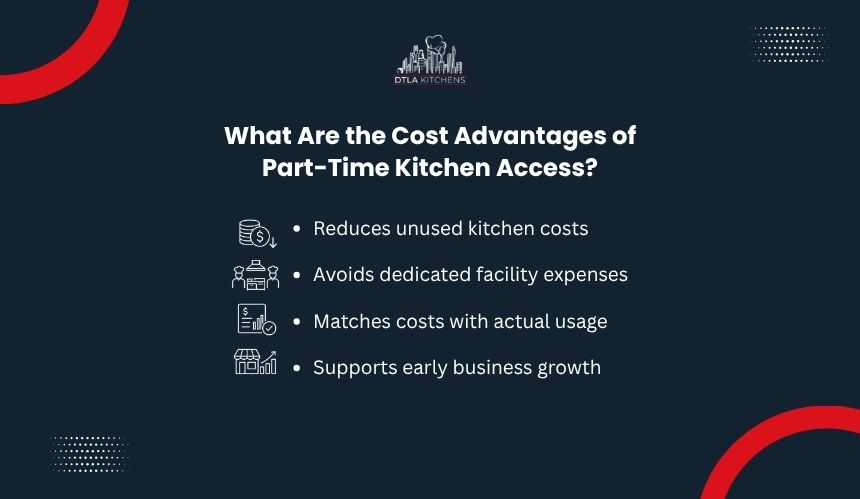
Part-time kitchen access can help food businesses align kitchen expenses more closely with actual production. Instead of taking on the financial responsibility of a dedicated facility that may remain unused for significant periods, operators can choose an access arrangement that better reflects how frequently they need professional kitchen space.
How Can Part-Time Access Reduce Unused Kitchen Costs?
A business producing only a few days each week may not receive enough value from paying for continuous kitchen availability. Part-time access can reduce spending on unused kitchen capacity, especially for businesses with scheduled, seasonal, or order-driven production.
Can Part-Time Kitchen Access Help Avoid the Cost of a Dedicated Facility?
Operating a dedicated commercial kitchen can involve rent, utilities, equipment, maintenance, cleaning, and other ongoing facility expenses. Using a shared kitchen part-time can let smaller operators access production space without immediately taking on the broader costs of maintaining their own facility.
Why Should Businesses Compare Kitchen Cost With Actual Usage?
The lowest monthly price does not automatically represent the best value. Operators should consider how many productive hours they receive, whether the required equipment is available, and whether scheduled access supports their workflow. A plan that closely matches actual usage can be more practical than paying for substantially more access than the business needs.
Can Part-Time Access Help During Early Business Growth?
Yes. Newer food businesses may still be determining their typical order volume and production schedule. Starting with part-time access can provide room to establish those patterns before committing to greater kitchen availability. As production becomes more consistent, the business can evaluate whether additional access is financially justified.
Did You Know?
Part-time kitchen access is not automatically the least expensive option at every production level. As reserved hours and production days increase, businesses should periodically compare what they are spending with the cost and capacity of other kitchen-access arrangements.
What Should You Consider Before Choosing Part-Time Kitchen Access?
Part-time kitchen access works best when the arrangement supports the entire production process, not simply the hours spent cooking. Before choosing a plan, food businesses should consider scheduling, equipment, storage, production volume, and how easily additional access can be added as demand changes.
Does the Available Schedule Match Your Production Days?
Kitchen availability should align with when production actually needs to happen. Caterers may need access before events, while bakers or market vendors may depend on specific production days each week. A part-time arrangement becomes difficult if suitable time slots are consistently unavailable when the business needs them.
Is the Equipment Suitable for Your Production Workflow?
Operators should identify the equipment their products require and determine whether the kitchen can support the expected production volume. Oven capacity, burners, refrigeration, sinks, preparation surfaces, and specialized equipment can influence both production speed and the number of kitchen hours required.
Is Enough Storage Available Between Kitchen Sessions?
Businesses that keep ingredients, packaging, or finished products between production days should understand the available storage arrangements. Refrigerated, frozen, and dry storage needs can affect whether part-time access works smoothly, especially when products can’t be transported in and out during every session.
How Flexible Is the Kitchen When Production Needs Change?
Production requirements can increase because of larger orders, seasonal demand, catering bookings, or business growth. Operators should consider whether they can schedule additional kitchen hours as needed. Limited flexibility may become a constraint even when the original part-time schedule worked well at a lower production volume.
Does the Access Plan Support the Entire Production Cycle?
A suitable schedule should provide enough time for preparation, cooking or baking, cooling where required, packaging, cleaning, and resetting the workspace. Estimating only active cooking time can result in bookings that are too short for the complete production cycle.
Important:
Before committing to part-time access, businesses should map out one complete production session from arrival through cleanup. This provides a clearer estimate of the kitchen hours, equipment, storage, and scheduling flexibility actually required.
When Should a Business Move Beyond Part-Time Kitchen Access?
Part-time access can support a food business effectively while production remains manageable within scheduled sessions. As demand grows, however, the same arrangement can begin limiting output or creating scheduling pressure. Recognizing these changes early helps operators decide when additional kitchen access may better support the way the business now operates.
What Happens When Production Regularly Exceeds Reserved Kitchen Hours?
Frequently running out of scheduled time can indicate that production volume has outgrown the current arrangement. If preparation, cooking, packaging, and cleanup consistently require additional hours, increasing kitchen access may provide a more workable schedule than repeatedly trying to compress production into limited sessions.
Does Needing More Production Days Signal a Change?
It can. A business that originally produced once or twice per week may gradually need additional sessions as orders increase. When extra production days become a regular requirement rather than an occasional need, the operator should reassess whether the existing part-time plan still matches actual kitchen usage.
Can Scheduling Constraints Limit Business Growth?
Yes. If available kitchen times prevent a business from accepting larger orders, adding sales days, or meeting production deadlines, access itself may have become a capacity constraint. More consistent kitchen availability can provide additional room for production without forcing every order into a narrow schedule.
When Do Storage and Equipment Needs Become a Limiting Factor?
Growth can increase the amount of ingredients, finished products, packaging, refrigeration, and equipment capacity a business requires. Even when scheduled hours remain manageable, insufficient storage or production capacity can indicate that the operation needs an access arrangement better suited to its increased scale.
Should Businesses Reevaluate Kitchen Access as They Grow?
Yes. Review kitchen requirements as production volume, order frequency, staffing, and product lines change. An arrangement that worked earlier may no longer be the most practical choice. Periodic reassessment helps ensure kitchen access continues to support, not restrict, production.
Did You Know?
Outgrowing part-time kitchen access does not necessarily mean immediately leasing a private commercial kitchen. The next step may simply involve increasing scheduled hours or choosing an access plan with greater availability as production becomes more frequent.
How Can Part-Time Kitchen Access Support a Growing Food Business?
Growth does not always require an immediate move into a dedicated commercial kitchen. When production is still concentrated into specific days or batches, part-time access can provide room to increase output while keeping kitchen use aligned with actual demand. The arrangement can also give operators useful insight into their changing space and capacity requirements.
Can Businesses Increase Production Without Immediately Leasing a Kitchen?
Yes. A food business may be able to increase its scheduled kitchen hours as orders grow rather than taking on a dedicated facility immediately. This can provide additional production capacity while the operator determines whether higher demand is consistent enough to justify a larger commitment.
How Can Scheduled Kitchen Access Help Businesses Test Demand?
New products, wholesale opportunities, catering contracts, and additional market dates can increase production temporarily or gradually. Part-time access allows operators to see how these opportunities affect kitchen usage before making a longer-term facility decision based on demand that may still be developing.
Can Part-Time Access Help Identify Future Kitchen Requirements?
Using a professional kitchen regularly gives operators practical information about their workflow. They can determine which equipment is used most, how much prep space is needed, how many production hours are required, and where storage or scheduling constraints begin to appear.
Why Is Scalability Important When Choosing Kitchen Access?
A suitable arrangement should not become restrictive as soon as production increases. Businesses should consider whether they can add hours or production sessions when needed. Having room to adjust access can make growth easier to manage without repeatedly changing the entire production setup.
How Does DLTA Kitchens Fit Into a Part-Time Production Strategy?
For businesses that do not yet require continuous kitchen availability, DLTA Kitchens can provide a professional kitchen environment that supports scheduled production. The key is selecting access based on current production requirements while regularly reassessing whether increasing orders, hours, or storage needs call for a different arrangement.
Important:
Part-time kitchen access should support growth rather than delay necessary changes. When additional hours, production days, or capacity become a consistent requirement, the business should reevaluate its access plan instead of forcing a growing operation into a schedule it has already outgrown.
Frequently Asked Questions
Part-time kitchen access allows a food business to use professional kitchen space during scheduled periods rather than maintaining continuous access. It can suit operators whose preparation and production can be completed on specific days or within predictable time blocks.
It can work well for caterers, bakers, meal-prep businesses, food trucks, pop-up operators, market vendors, and small food brands. The best candidates typically have predictable production schedules and can complete their kitchen work within reserved sessions.
Required hours depend on production volume, menu or product complexity, equipment, staffing, and workflow. Businesses should calculate time for setup, preparation, cooking or baking, cooling, packaging, cleaning, and workspace reset rather than estimating kitchen needs from cooking time alone.
It can be more cost-effective when a business only needs kitchen space for limited production periods. However, operators should regularly compare actual usage and costs. As production hours increase, another access arrangement may eventually provide better capacity or value.
Yes. Part-time access lets a growing operation establish production patterns and test rising demand before taking on greater kitchen commitments. Businesses should monitor order volume, kitchen hours, storage needs, and scheduling pressure as production expands.
A change may be appropriate when production repeatedly exceeds reserved hours, additional kitchen days become routine, storage becomes insufficient, or scheduling limits new orders. These patterns can indicate that the business now requires more consistent kitchen availability or greater production capacity.