- DTLA Kitchens
How Private Kitchen Space Supports Higher Production Volume
Quick AnswerPrivate kitchen space increases production volume by giving food businesses dedicated access to equipment, storage, workstations, and production time. It is most useful when shared-kitchen limits cause recurring delays, missed orders, inefficient labor, or inconsistent scheduling.
|
As food businesses increase order volume, limited kitchen access can become a direct constraint on production capacity. Shared schedules, restricted equipment availability, insufficient storage, and repeated setup can reduce the number of batches a team can complete within a working day.
Private kitchen space gives operators greater control over production time, workflow, equipment, and staffing, making higher output more practical and predictable. This blog explains how dedicated kitchen space supports increased production volume and when moving to a private setup can make operational sense.
Why Production Volume Becomes Difficult to Increase in Limited-Access Kitchens
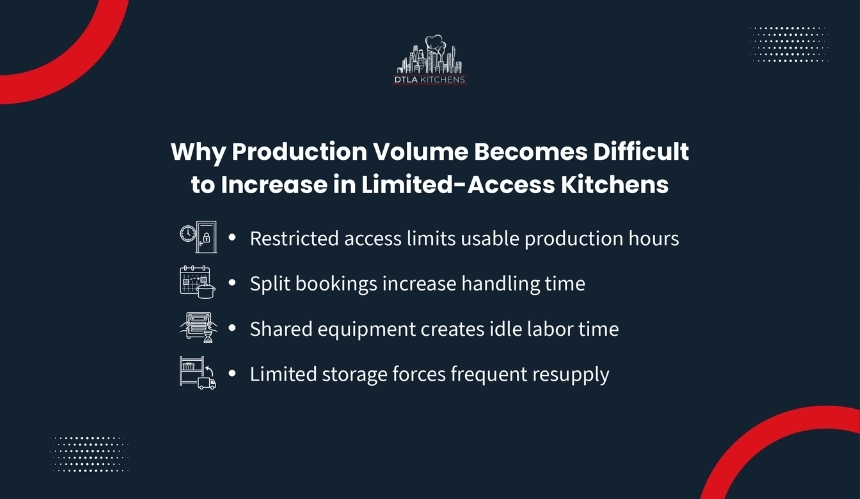
Production volume often reaches a ceiling when the kitchen cannot provide enough uninterrupted time, equipment access, or storage capacity to support additional output. These constraints can limit growth even when demand, labor, and ingredients are available.
How Do Scheduling Restrictions Limit Production Hours?
Restricted kitchen access reduces the number of usable production hours available within a day or week. When operators depend on reserved time blocks, production schedules are shaped by facility availability rather than actual order demand, placing a fixed limit on how many batches can be completed.
Scheduling restrictions can also disrupt the sequence between preparation, cooking, cooling, packaging, and sanitation. If access ends before the full production cycle is complete, teams may need to split work across multiple bookings, increasing handling time and reducing overall throughput.
How Does Shared Equipment Create Workflow Delays?
Shared ovens, mixers, ranges, sinks, refrigeration units, and prep stations can become production bottlenecks when multiple operators need the same equipment. If one stage is delayed, dependent tasks may also stop, creating idle labor time and reducing the amount of finished product completed during a reserved shift.
The impact becomes more significant as production volume increases because high-output workflows depend on predictable equipment availability. Consistent access to critical machinery allows batches to move through each stage on schedule, while repeated waiting reduces effective kitchen capacity.
Why Does Limited Storage Make Higher-Volume Production Harder?
Limited dry, refrigerated, or frozen storage restricts how much inventory a business can keep close to the production area. Operators may need to purchase ingredients in smaller quantities, replenish supplies more frequently, or transport materials between off-site storage and the kitchen.
Higher production volume also requires more space for packaging materials, prepared ingredients, work-in-progress, and finished products. When storage capacity does not scale with output, additional handling and workspace congestion consume time that could otherwise be used for production.
How Private Kitchen Space Increases Production Capacity
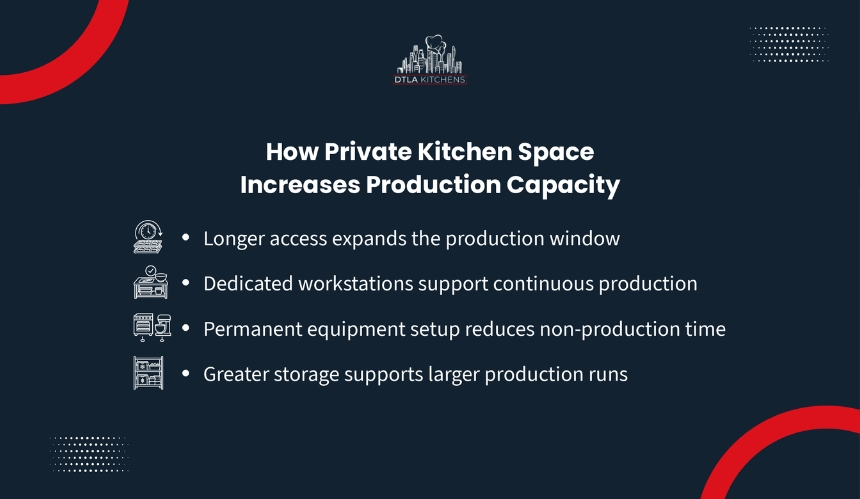
Private kitchen space increases production capacity by giving a food business greater control over time, layout, equipment placement, and inventory. That control allows more of the working day to be converted into productive output rather than access management.
How Does Longer Kitchen Access Increase Production Volume?
Longer access expands the usable production window, allowing teams to add more batches, extend preparation periods, and complete production cycles without compressing work into short booking slots. This creates more flexibility to align output with actual order volume rather than facility availability.
The 2022 FDA Food Code sets a model cooling standard for time/temperature control foods of 135°F to 70°F within two hours and 41°F or below within six total hours, showing why sufficient production time must account for food-safety processes as well as active cooking. |
Extended access also improves scheduling precision for processes that require waiting periods, cooling, resting, proofing, freezing, or staged preparation. Instead of interrupting these processes to match a rental window, operators can structure the production day around the product’s actual requirements.
How Do Dedicated Workstations Support Continuous Production?
Dedicated workstations allow prep, cooking, cooling, packaging, and cleaning activities to remain organized without being repeatedly reassigned for different users. Each production zone can be arranged around the specific tools, surfaces, and materials required for that stage.
This setup supports continuous movement through the production line because teams do not need to clear, relocate, or rebuild stations between tasks. A stable layout also reduces unnecessary movement, making it easier to maintain a consistent flow as order volume increases.
Why Does a Permanent Equipment Setup Improve Throughput?
A permanent equipment setup reduces non-production time by keeping approved tools, smallwares, appliances, and operational materials in their intended positions. Staff can begin work sooner because they are not repeatedly unpacking equipment, verifying placement, or rebuilding the same production configuration.
Consistent equipment positioning also improves process standardization. When machinery and tools remain in fixed locations, teams can establish repeatable task sequences, reduce unnecessary handling, and maintain a more predictable production pace across shifts.
How Does Greater Storage Capacity Support Larger Production Runs?
Greater storage capacity allows businesses to hold larger quantities of ingredients, packaging materials, and production supplies on-site. This supports larger batch planning because inventory can be purchased and staged in quantities that match expected output rather than the limits of temporary storage.
Dedicated cold, frozen, and dry storage also improves production continuity by reducing dependency on frequent replenishment. When materials are available where they are needed, teams can move directly from one production run to the next with fewer interruptions caused by inventory movement or resupply.
How a Dedicated Kitchen Improves Production Workflow
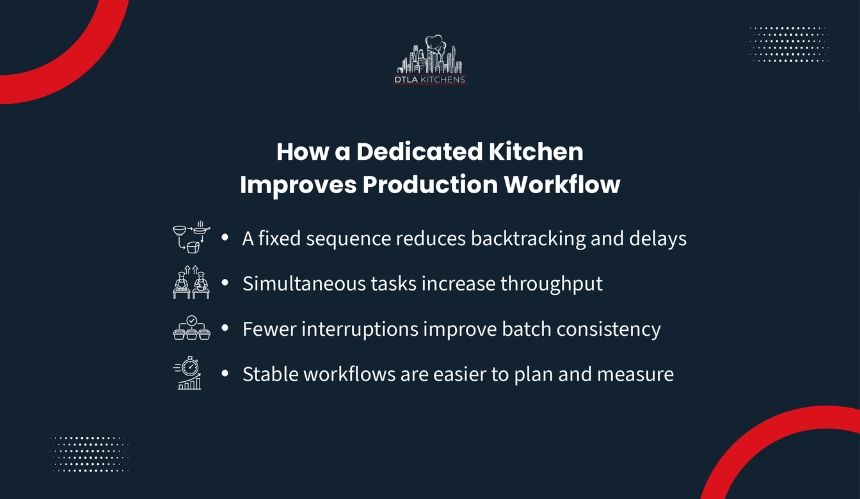
A dedicated kitchen improves production workflow by allowing each stage of food preparation to follow a stable, repeatable sequence. Instead of adapting processes around changing space conditions, operators can design the workflow around speed, product handling, and task coordination.
Did you know? A well-planned commercial kitchen layout can reduce unnecessary staff movement between prep, cooking, storage, and packaging areas, helping shorten production cycles and improve overall throughput.
How Can Production Stages Be Organized in a Fixed Sequence?
A fixed production sequence allows ingredients and products to move logically from receiving and preparation to cooking, cooling, packaging, and dispatch. When each stage has a defined place in the workflow, teams can reduce backtracking, unnecessary movement, and delays caused by poorly coordinated handoffs.
A 2020 lean-management case study in food service found that reorganizing workstations and applying 5S principles recovered about 30% of workspace, while the redesigned layout reduced preparation times and increased the number of meals served on time. |
This structure also makes production easier to plan and measure. Operators can identify where time is being lost, estimate how long each stage should take, and adjust process order without changing the entire kitchen setup. That visibility becomes increasingly valuable as batch sizes and daily order counts grow.
How Do Simultaneous Tasks Increase Kitchen Throughput?
A dedicated kitchen can support multiple production activities at the same time when work zones are arranged to prevent one task from blocking another. One team member can prepare ingredients while another manages cooking, packaging, or sanitation, allowing several parts of the production cycle to progress in parallel.
Parallel task execution shortens the total time required to complete a production run because work no longer depends entirely on a single linear sequence. This can increase throughput without requiring every individual task to become faster, since overall output improves through better coordination between stages.
Why Do Fewer Interruptions Improve Batch Consistency?
Fewer interruptions create more stable processing conditions, which makes it easier to follow standardized recipes, timing requirements, portion controls, and handling procedures. When employees can complete tasks without repeated changes in workspace or workflow, process variability is reduced.
Greater consistency is especially important at higher production volumes because small deviations can multiply across large batches. A controlled operating environment supports more uniform results in cooking time, portion size, packaging, and finished product quality, helping businesses scale output without sacrificing process reliability.
How Private Kitchen Space Supports a Larger Production Team
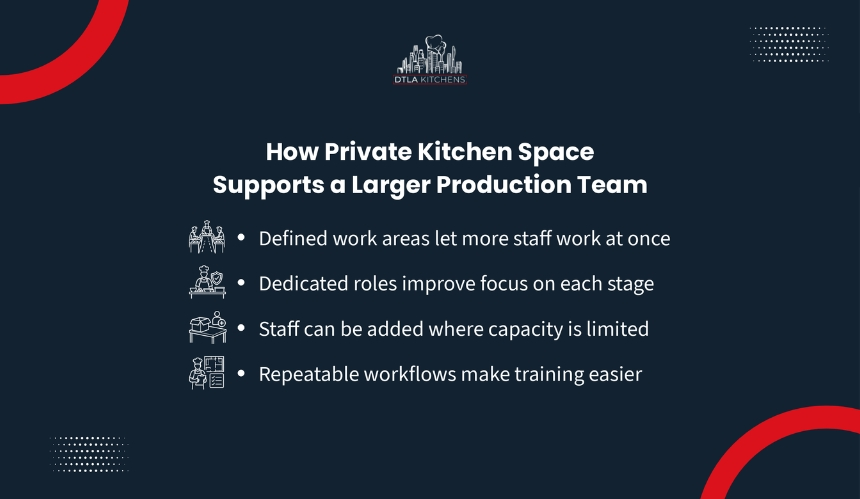
Private kitchen space supports team expansion by giving staff enough room, defined work areas, and stable operating procedures to work together without creating congestion. As production volume grows, labor capacity becomes more effective when responsibilities can be distributed across the kitchen rather than concentrated around a few shared tasks.
How Can More Staff Work During the Same Production Window?
A larger production team can increase output only when employees have sufficient space to perform tasks without interfering with one another. Dedicated prep tables, cooking areas, packaging stations, and sanitation zones allow multiple employees to work concurrently while maintaining clear movement paths through the kitchen.
This reduces the productivity losses that occur when workers must wait for counter space, reposition equipment, or move around overlapping tasks. With enough functional workspace, adding labor can translate into greater productive capacity instead of creating additional congestion.
How Does Dividing Roles by Production Stage Improve Output?
Assigning employees to defined production stages creates clearer responsibility for preparation, cooking, portioning, packaging, inventory handling, and sanitation. Each worker can focus on a specific part of the process rather than repeatedly switching between unrelated tasks during the same production run.
Role specialization also makes labor allocation easier to adjust as demand changes. If packaging becomes the limiting stage, additional staff can be assigned there without reorganizing the entire workflow, allowing operators to address specific capacity constraints more precisely.
Why Do Repeatable Workflows Make Staff Training Easier?
A consistent kitchen layout gives new employees a stable environment in which equipment locations, work zones, storage areas, and process sequences remain predictable. Training can therefore focus on production standards and task execution rather than teaching staff how to adapt to changing workspace conditions.
Repeatable procedures also make performance expectations easier to document and supervise. Standard operating procedures for portioning, equipment use, sanitation, labeling, and handoffs can be applied consistently across shifts, which reduces onboarding variability as the production team expands.
When Moving to Private Kitchen Space Makes Sense for Higher Production
Moving to private kitchen space makes the most sense when production constraints are recurring, measurable, and beginning to affect revenue or fulfillment reliability. The decision should be based on operating data rather than growth expectations alone.
When Does Demand Exceed Current Kitchen Capacity?
Demand exceeds current kitchen capacity when the business regularly cannot complete planned orders within its available production schedule. Repeated backlogs, declined orders, delayed fulfillment, or the inability to add another batch indicate that the existing kitchen model is limiting output.
The key distinction is consistency. A temporary surge may not justify a larger commitment, but recurring capacity shortages across normal operating periods suggest that the business has outgrown its current access level and needs more production control.
Are Shared-Kitchen Limitations Increasing Operating Costs?
Shared-kitchen constraints can become financially significant when they create repeated overtime, transportation, setup, storage, or labor inefficiencies. These costs may not appear in the base rental rate, but they increase the effective cost of producing each unit.
Tracking these expenses helps determine whether a private kitchen would improve unit economics. If additional access reduces paid downtime, unnecessary handling, off-site storage, or repeated logistics, the higher fixed facility cost may be offset by lower operational waste.
When Is Predictable Production Scheduling Necessary?
Predictable scheduling becomes critical when a business serves wholesale accounts, recurring catering clients, retailers, delivery programs, or other customers with fixed fulfillment requirements. These channels depend on reliable production timing because missed output can affect inventory availability, delivery windows, and customer relationships.
A private kitchen provides greater control over when production begins, how long it runs, and when finished orders are ready for dispatch. That consistency allows businesses to commit to recurring order schedules with less exposure to facility-related delays.
How Should Added Kitchen Cost Be Compared With Added Capacity?
The financial decision should compare total occupancy cost with the additional productive capacity the space can realistically generate. Operators should evaluate rent, utilities, storage, equipment, labor, maintenance, and contractual obligations against expected increases in batch volume and fulfilled orders.
The most useful measure is not simply whether private space costs more, but whether it lowers the cost or risk of producing each additional unit. If higher throughput, stronger fulfillment reliability, and better labor utilization generate enough incremental margin, the move can support sustainable production growth.
Scaling Production with Private Kitchen Space
Private kitchen space can support higher production volume when a food business needs more control over capacity, staffing, scheduling, and day-to-day operations. The strongest case for moving to a dedicated facility exists when existing constraints are consistently limiting fulfilled orders, increasing operating costs, or making production less predictable.
The decision should ultimately be based on measurable output requirements and financial performance. When additional kitchen capacity produces enough incremental volume, labor efficiency, and fulfillment reliability to justify the added occupancy cost, private space becomes an operational investment rather than simply a larger facility.
Ready to increase production without letting kitchen limitations slow you down? DTLA Kitchens offers flexible commercial kitchen solutions across Southern California, including kitchen studios, part-time and full-time kitchens, bakery kitchens, ice cream kitchens, and kosher kitchen space. Find the setup that fits your operation and scale production with greater control, consistency, and room to grow.
Frequently Asked Questions
A compliant commercial kitchen does not automatically authorize every food business operating inside it. Permits can depend on the operator, menu, production method, sales channels, and local health regulations. Before signing, confirm whether your operation requires separate food permits, inspections, business registration, or approvals for wholesale or interstate distribution.
Verify electrical amperage, gas availability, water supply, drainage, grease management, HVAC, ventilation, and exhaust capacity against your actual equipment load. High-output ovens, refrigeration, fryers, dishwashers, or blast chillers can exceed a building's existing infrastructure, potentially requiring costly upgrades or limiting which equipment can operate simultaneously.
Installation rights depend on the facility and lease terms. Confirm whether the landlord permits additional ovens, mixers, refrigeration, proofers, fryers, or processing equipment and whether electrical, gas, plumbing, ventilation, or fire-suppression modifications are required. The agreement should also establish who pays for installation, maintenance, code upgrades, and removal at lease end.
Exclusive space can provide stronger control over allergen segregation because utensils, preparation zones, ingredients, oils, and sanitation procedures do not need to accommodate unrelated operators. However, private access does not eliminate cross-contact automatically. Effective allergen management still requires documented cleaning procedures, dedicated equipment where necessary, ingredient controls, staff training, and disciplined production sequencing.
Focus on lease length, renewal options, expansion rights, equipment-installation permissions, repair responsibilities, utility charges, tenant improvements, and exit provisions. A facility may suit current production but become restrictive if the agreement prevents modifications or expansion. Clarifying these terms before occupancy reduces the risk of needing another relocation as operational requirements change.
Private kitchen rental can serve as an intermediate scaling model between shared commissary use and owning a dedicated facility. It provides exclusive commercial production space without requiring the full capital commitment of property acquisition and ground-up buildout. The better choice depends on expected occupancy duration, customization needs, financing capacity, and long-term production requirements.