
- dtlta-Kitchens
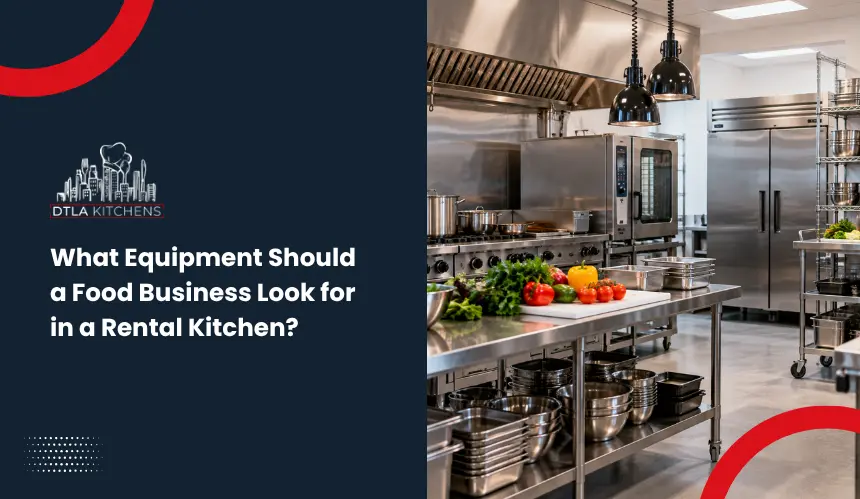
What Equipment Should a Food Business Look for in a Rental Kitchen?
Quick AnswerChoose a rental kitchen based on production fit, not equipment count. Verify that cooking equipment, refrigeration, prep space, storage, sanitation systems, and utilities can support your menu, batch size, and workflow. Also check equipment condition, shared-access rules, and added fees to determine the kitchen’s true operating value. |
Choosing a rental kitchen involves more than confirming that commercial appliances are available. The equipment must match your menu, production volume, food-safety requirements, and workflow or the kitchen can create bottlenecks that increase labor time and operating costs.
A food business should evaluate cooking equipment, refrigeration, prep space, sanitation systems, storage capacity, and supporting utilities based on how production actually runs. This guide explains what equipment to look for in a rental kitchen and how to determine whether the facility can reliably support your current operations and future demand.
What Cooking Equipment Does Your Food Business Actually Need?
The right rental kitchen should provide cooking equipment that matches how your products are prepared, how much you produce, and how quickly orders must move through the kitchen. A long equipment list has limited value if the appliances cannot support your actual production methods or batch sizes.
Did You Know? In Orange County, food businesses often serve everything from local catering orders to farmers markets and specialty retail, so equipment needs can shift quickly as production volume grows. Choosing a rental kitchen with the right oven capacity, prep equipment, and workflow support can make scaling far easier than relying on a facility with more appliances but less usable capacity.
Commercial Ranges, Ovens, and Cooktops
Commercial ranges and ovens form the core production system for many food businesses, but the required configuration depends on the menu. A catering business preparing sauces, proteins, and large-volume dishes may need multiple burners and high-capacity ovens, while a bakery may depend more heavily on consistent heat distribution, rack space, and controlled baking temperatures.
Convection ovens support faster, more even airflow across multiple trays, while deck ovens suit products that require direct heat from a baking surface. Combination ovens add flexibility by integrating convection and steam, and the choice between gas and electric equipment should be based on cooking response, heat consistency, utility compatibility, and the production methods used most often.
Griddles, Grills, Fryers, and Specialty Cooking Equipment
Businesses producing high volumes of grilled, fried, or flat-top menu items should confirm that dedicated equipment is available rather than relying on general-purpose ranges. Commercial griddles, charbroilers, and fryers are designed to maintain working temperatures during repeated production, which directly affects cooking speed, consistency, and order capacity.
Specialty appliances such as steam kettles, tilt skillets, pizza ovens, rice cookers, or smokers should be evaluated according to how central they are to the menu. Equipment that supports a core revenue-producing product can determine whether the kitchen is operationally suitable, while appliances that are rarely used provide little practical value.
Mixers, Processors, Slicers, and Production Equipment
Mechanical preparation equipment can reduce labor requirements when a business produces repetitive batches or processes large ingredient volumes. Commercial mixers, food processors, slicers, dough sheeters, immersion blenders, and similar machines improve consistency while reducing the amount of manual preparation required before cooking begins.
Capacity and included accessories should be checked before relying on any machine. A mixer that cannot handle a standard dough batch or a processor supplied without the required blade can slow production despite appearing on the kitchen’s equipment list, so bowls, attachments, guards, blades, and other operating components should be confirmed in advance.
Why Equipment Capacity Matters as Much as Availability
Equipment should be evaluated by usable output rather than simple availability. Burner count, oven rack capacity, fryer recovery rate, mixer volume, and cooking surface area determine how much food can move through production during each rental period.
Undersized equipment forces businesses to divide normal production into smaller batches, creating wait time between cycles and increasing labor hours. Comparing expected batch size with actual appliance capacity provides a more accurate measure of whether the rental kitchen can support efficient production without unnecessary delays.
What Prep, Refrigeration, and Storage Equipment Should Be Available?
Preparation, cold storage, and ingredient organization determine how efficiently food can move from receiving to production. A rental kitchen should provide enough usable workspace and storage capacity to support the business without creating congestion, cross-contact risks, or repeated handling.
Stainless-Steel Prep Tables and Dedicated Workstations
Stainless-steel prep tables provide durable, nonporous work surfaces for ingredient preparation, assembly, portioning, and packaging. The available surface area should reflect the number of employees working simultaneously and the amount of food being processed, since limited bench space can force unrelated tasks into the same workstation and disrupt production flow.
Dedicated workstations become especially valuable when a business handles raw proteins, allergens, baked goods, ready-to-eat foods, or separate production stages. Clear separation allows each task to remain organized while reducing unnecessary movement between stations, so businesses should assess table dimensions, placement, accessibility, and proximity to sinks, refrigeration, and cooking areas.
Refrigerators, Freezers, and Cold-Storage Capacity
Commercial refrigeration should provide enough usable space for ingredients, prepared components, finished products, and temperature-sensitive supplies throughout the rental period. Reach-in refrigerators offer convenient access during active production, while walk-in coolers and freezers are better suited to larger inventories, bulk ingredients, and higher-volume operations.
Businesses should evaluate actual shelf and container capacity rather than relying on the presence of a refrigerator or freezer alone. Shared kitchens may divide cold storage among multiple tenants, which can reduce the space available to each business and affect purchasing volume, batch planning, and the amount of prepared food that can be held safely between production stages.
Dry Storage, Shelving, and Ingredient Organization
Dry storage should accommodate shelf-stable ingredients, packaging materials, containers, spices, and other supplies without crowding active preparation areas. Commercial shelving should keep products elevated, accessible, and organized so staff can locate ingredients quickly while maintaining a clear distinction between food, packaging, and non-food items.
Rental kitchens may provide shared shelving, assigned storage areas, locking cages, or dedicated tenant space, and these arrangements should be reviewed before inventory is brought onsite. A business that stores flour, oils, canned goods, disposable packaging, or bulk ingredients may require substantially more dry-storage capacity than an operation that brings only same-day production supplies.
Smallwares and Frequently Overlooked Prep Equipment
Smallwares often determine whether a kitchen is immediately usable even when major appliances are already installed. Sheet pans, hotel pans, mixing bowls, cutting boards, scales, measuring tools, food-grade containers, cooling racks, utensils, and knives support the routine tasks that connect ingredient preparation with cooking and packaging.
Businesses should confirm which items are supplied, which are shared, and which must be brought independently. Missing smallwares can create unexpected setup costs or production delays, particularly when specialized pan sizes, calibrated scales, storage containers, or food-contact tools are required for standardized recipes and portion control.
Which Sanitation and Food-Safety Equipment Should You Check?
Sanitation equipment should support safe food handling without forcing cleaning, preparation, and handwashing tasks into the same space. A rental kitchen must provide the fixtures and systems needed to control contamination, maintain sanitary conditions, and support compliant daily operations.
Important: Before renting a kitchen, verify that handwashing, food-preparation, and warewashing areas are clearly separated and fully functional. Poor sink placement or shared-use conflicts can disrupt sanitation procedures, increase cross-contamination risk, and make routine food-safety compliance harder to maintain during production.
Handwashing and Food-Preparation Sinks
Dedicated handwashing sinks should be accessible from active work areas so staff can wash their hands without interrupting food-preparation or warewashing tasks. These sinks should remain available for hand hygiene rather than being used for rinsing ingredients, utensils, or equipment, since combining functions can increase contamination risk.
Food-preparation sinks serve a different operational purpose and may be needed for washing produce, thawing certain foods under controlled conditions, or handling ingredients that require water access. Businesses should confirm that sink placement, drainage, and intended use align with their production process, especially when raw and ready-to-eat foods are handled in the same facility.
Three-Compartment Sinks and Commercial Dishwashing Equipment
A three-compartment sink supports separate washing, rinsing, and sanitizing steps for utensils, cookware, and food-contact equipment. The sink must be large enough for the items used in production, because oversized pots, sheet pans, or mixer components can be difficult to clean effectively when basin dimensions are inadequate.
Commercial dishwashers can reduce manual labor and increase warewashing throughput, but their value depends on cycle speed, rack capacity, and compatibility with the kitchen’s workload. Businesses producing multiple batches within a short rental window should assess whether dirty equipment can be cleaned and returned to service quickly enough to avoid interrupting production.
Ventilation, Exhaust Hoods, and Fire-Suppression Systems
Cooking equipment that generates heat, grease, smoke, or vapor may require an appropriate commercial exhaust system to remove contaminants from the cooking area. Hood coverage should correspond with the appliances being used, since operating high-heat or grease-producing equipment outside an approved ventilation setup can create safety and compliance problems.
Fire-suppression systems are commonly integrated with commercial hood assemblies to respond to cooking-related fires in protected areas. Renters should verify that the hood, filters, exhaust components, and suppression system are maintained and compatible with the intended equipment rather than assuming every cooking appliance can be used under the same ventilation configuration.
Temperature-Control and Food-Safety Tools
Temperature-control tools allow staff to verify whether food is being cooked, cooled, held, and stored within safe operating ranges. Probe thermometers, refrigerator thermometers, hot-holding units, and cold-holding equipment provide measurable controls that support consistent food-safety procedures during production.
Businesses should also confirm that these tools are functional, accessible, and appropriate for the products being prepared. Reliable temperature monitoring is particularly important when food moves through several stages, because delays during cooling, holding, or storage can create safety risks even when the cooking process itself is properly controlled.
Can the Kitchen Equipment Handle Your Production Volume?
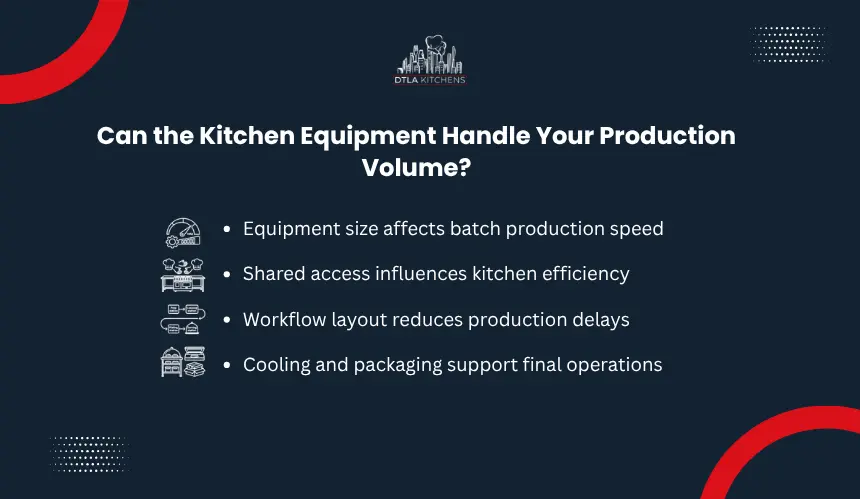
A rental kitchen may contain the right categories of equipment but still fall short during peak production. The key issue is whether the facility can support your expected throughput, staffing level, and production sequence within the hours you are paying to use the space.
Equipment Size and Batch Capacity
Production volume should be matched to the working capacity of each major appliance, not just its presence in the kitchen. Oven cavity size, fryer basket capacity, kettle volume, mixer bowl size, and available burner space all influence how much product can be processed during a single cycle.
When capacity is too low, businesses are forced into additional production rounds, which extends prep time, cooking time, and labor requirements. A better fit is a kitchen where standard batch sizes can move through the required equipment without repeated resizing or unnecessary scheduling gaps.
Equipment Availability During Shared Kitchen Hours
In a shared commercial kitchen, access can be as important as equipment capacity. An oven, mixer, prep station, or sink may be technically available, but simultaneous use by other tenants can create delays that are difficult to predict during busy rental periods.
Food businesses should review reservation rules, dedicated-use policies, and peak-hour demand before relying on shared equipment. If critical appliances frequently require waiting or advance booking, the resulting interruptions can reduce hourly output and make production planning less reliable.
Workflow Between Storage, Prep, Cooking, Cooling, and Packaging
Production efficiency depends on how easily food moves between each operational stage. Poorly positioned equipment can create excessive walking, backtracking, or congestion between refrigeration, prep areas, cooking stations, cooling zones, and packaging surfaces.
A stronger layout supports a logical sequence from ingredient retrieval to finished-product staging with minimal cross-traffic. This becomes more significant as staff numbers increase, because inefficient movement can create bottlenecks even when individual appliances are adequately sized.
Cooling, Holding, and Packaging Requirements
Some food businesses need more than cooking equipment to maintain production speed after food leaves the heat source. Speed racks, cooling space, blast chillers where applicable, hot-holding cabinets, packing tables, and staging areas can determine how quickly finished batches are stabilized and prepared for storage, transport, or sale.
These support systems should match the product’s handling needs and production schedule. A kitchen that can cook large quantities but lacks adequate cooling or packaging capacity may simply shift the bottleneck downstream, limiting how much finished product can be completed during the rental period.
What Equipment Details Should You Verify Before Renting?
Before committing to a rental kitchen, verify the operational details behind the equipment list. Availability, condition, utility support, and rental terms can determine whether the facility works as expected once production begins.
Did You Know? In Orange County, rental kitchen operators may serve businesses with very different production schedules, from caterers to packaged-food brands. Verifying equipment access, utility compatibility, maintenance procedures, and usage fees before signing can prevent unexpected downtime or added costs once regular production begins.
Confirm What Equipment Is Included in the Rental Rate
A listed appliance is not always included in the standard hourly or monthly rental rate. Some kitchens charge separately for specialty ovens, mixers, cold storage, speed racks, smallwares, or dedicated workstations, which can materially change the total cost of production.
Ask for a written breakdown of included equipment, add-on fees, storage charges, cleaning costs, and any minimum-use requirements. This makes it easier to compare facilities on actual operating cost rather than relying on an advertised rate that excludes equipment your business needs regularly.
Check Equipment Condition, Maintenance, and Reliability
Commercial equipment should be inspected for cleanliness, visible wear, temperature stability, damaged controls, loose components, and signs of inconsistent performance. A machine that operates intermittently can create more disruption than equipment that is unavailable from the start because production plans may depend on it.
Review how the facility handles preventive maintenance, repairs, and equipment failures during booked kitchen time. Clear procedures for reporting problems and accessing replacement equipment reduce the risk of losing paid production hours when an appliance becomes unusable.
How Do You Choose Between Two Rental Kitchens With Similar Equipment?
When two rental kitchens appear comparable on paper, the better choice is usually the one that delivers stronger operational fit rather than the larger equipment inventory. The decision should focus on access, usable capacity, cost efficiency, and how well the facility supports the business’s actual production model.
Prioritize Critical Equipment Over Unnecessary Extras
Essential equipment should carry more weight than specialty appliances that rarely support routine production. A kitchen with dependable access to the ovens, burners, refrigeration, prep stations, or mixers your business uses every session may provide more value than a facility with a broader but less relevant equipment list.
Create a short list of non-negotiable appliances based on the products that generate most of your production volume. If either kitchen lacks reliable access to one of these core systems, that limitation should outweigh the presence of additional equipment that does not contribute directly to daily output.
Compare Usable Capacity Instead of Equipment Count
Two kitchens can list the same number of appliances while offering very different production capabilities. Differences in oven dimensions, refrigeration allocation, worktable space, sink access, rack capacity, and the number of employees who can work comfortably at the same time can significantly affect practical output.
Evaluate how much usable capacity your business would actually receive during a normal rental session. A facility with fewer but larger or better-positioned appliances may support higher throughput than a kitchen with more equipment that is undersized, crowded, or divided among multiple users.
Factor Equipment Access Into the True Rental Cost
The lowest hourly rate does not always produce the lowest cost per batch. Equipment surcharges, restricted access periods, storage fees, minimum bookings, and time lost waiting for shared appliances can increase the effective cost of completing each production run.
Compare kitchens using the estimated total cost required to produce the same amount of finished product. This approach connects rental pricing with actual productivity and can reveal that a higher-priced facility is more economical when it allows faster, more predictable use of critical equipment.
Ready to find a kitchen that fits your production needs? DTLA Kitchens offers flexible commercial kitchen solutions across Southern California, including kitchen studios, part-time and full-time kitchens, bakery kitchens, ice cream kitchens, and kosher kitchens. Explore a space designed to support your workflow, equipment needs, and business growth.
Frequently Asked Questions
Many rental kitchens allow tenant-owned equipment, but approval may depend on electrical load, gas connections, ventilation requirements, sanitation standards, and facility insurance policies. Before bringing mixers, sealers, induction units, or specialty appliances, confirm whether the kitchen requires equipment specifications, commercial certification, or prior approval from facility management.
A licensed rental kitchen provides an approved commercial food-production environment, but individual businesses may still need their own permits, registrations, or food-handler certifications. Requirements vary by product type and local jurisdiction, so operators should confirm responsibilities with the relevant health department before beginning production or selling packaged, catered, or prepared foods.
Overnight storage depends on the rental kitchen’s tenant policies and available dedicated space. Some facilities offer assigned refrigeration, freezer shelves, dry-storage lockers, or long-term storage for an additional fee. Businesses should confirm labeling rules, access hours, inventory limits, and whether finished products can remain onsite between scheduled production sessions.
Many shared commercial kitchens require renters to carry general liability or product liability insurance before using the facility. Coverage protects against claims involving foodborne illness, property damage, or injuries connected to business operations. Some kitchens may also require proof of insurance naming the facility as an additional insured party.
Shared kitchens typically rely on cleaning protocols, designated storage, labeling, scheduling controls, and sanitation procedures to reduce allergen cross-contact. Businesses producing allergen-free or sensitive products should ask how shared equipment is cleaned, whether dedicated tools are available, and whether production can be scheduled separately from businesses handling major allergens.
Booking lead time depends on kitchen demand, equipment requirements, production duration, and preferred hours. High-demand evening or weekend slots may fill earlier than off-peak periods. Businesses with fixed delivery dates, catering events, or large production runs should reserve recurring time blocks early enough to secure consistent access to the equipment they depend on.
Commercial rental kitchens can support packaged foods when the facility, equipment, and business approvals match the product and process. Producers should evaluate cooling, labeling, sealing, storage, and batch-tracking needs in addition to cooking capacity. Shelf-stable, refrigerated, and frozen products may also be subject to different regulatory requirements.