
- dtlta-Kitchens
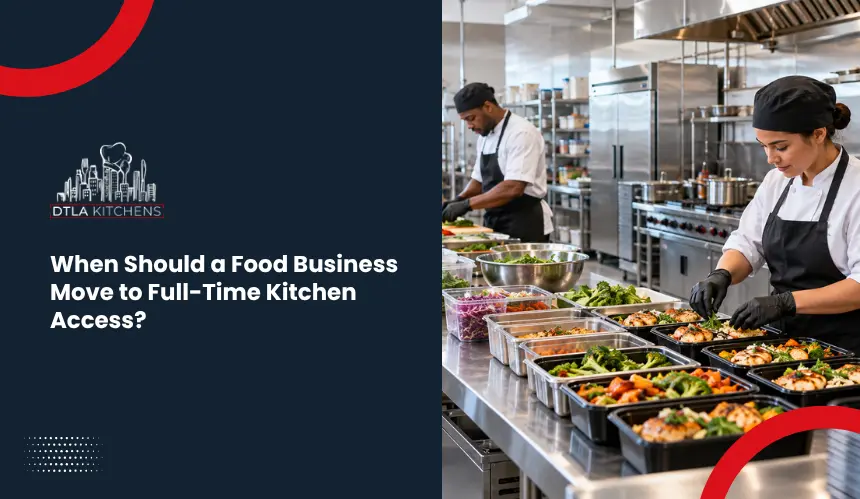
When Should a Food Business Move to Full-Time Kitchen Access?
Key Takeaways:
|
A food business should consider full-time kitchen access when limited scheduling, production capacity, or storage begins restricting daily operations and revenue growth. Frequent kitchen bookings, expanding order volume, and repeated setup requirements can signal that part-time access no longer fits the business model.
The decision should be based on how consistently the business uses kitchen space and whether greater access would remove measurable operational constraints. This blog explains the key signs, financial considerations, and practical factors that indicate when moving to full-time kitchen access makes sense.
What Changes When a Food Business Needs More Kitchen Access?
A food business usually needs more kitchen access when production requirements begin exceeding the time, space, or workflow available under its current arrangement. The pressure often appears first in scheduling, batch preparation, and the amount of non-production work required around each kitchen session.
Production Starts Outgrowing Available Kitchen Hours
Higher order volume increases the number of prep, cooking, cooling, packaging, and sanitation hours required to complete production. Once those tasks can no longer fit comfortably within reserved kitchen windows, the business begins operating against a fixed capacity limit.
This is especially relevant for caterers, bakers, meal-prep companies, and packaged food producers that process work in batches. A larger batch may require additional preparation time, longer equipment use, more cooling or holding time, and extra packaging labor. If kitchen access cannot expand with those requirements, production volume becomes constrained by available hours rather than customer demand.
Kitchen Scheduling Begins Controlling the Business
Limited access becomes a larger operational issue when production must be planned around kitchen availability instead of order deadlines. Businesses may be forced to move prep days, split production across multiple sessions, or reject short-notice orders because suitable time slots are unavailable.
This creates a dependency between facility scheduling and fulfillment capacity. A catering company, for example, may have sufficient staff and ingredients for a large event but still be unable to accept the booking if the necessary kitchen hours are already reserved. At that point, access to production space is directly influencing which sales opportunities the business can pursue.
Setup and Breakdown Time Reduces Productive Hours
Part-time kitchen use often requires ingredients, utensils, packaging supplies, and small equipment to be transported, organized, and removed during every session. These repeated setup and breakdown tasks consume time that could otherwise be used for food preparation and production.
The impact becomes greater as operations become more complex. More menu items, larger ingredient inventories, and additional packaging requirements increase the amount of material that must be staged before production begins. When a meaningful portion of each booked shift is spent preparing the workspace or clearing it afterward, the effective cost of productive kitchen time rises even if the rental rate remains unchanged.
Key Signs It May Be Time to Move to Full-Time Kitchen Access
The clearest signals appear when limited-access kitchen use starts creating recurring operational friction rather than occasional inconvenience. These indicators show that the current access model may no longer match the business’s production rhythm, storage needs, or staffing requirements.
Important: For food businesses in Los Angeles, a kitchen studio can work well while production remains flexible and relatively light, but frequent scheduling conflicts, limited storage, or rising weekly kitchen use may signal that a part-time or full-time commercial kitchen setup is becoming a better operational fit.
You Need Kitchen Access Most Days of the Week
A business that books kitchen space on most operating days is already functioning with near-continuous production needs. At that stage, part-time access can become administratively inefficient because the business must repeatedly secure time slots just to maintain its normal schedule.
Frequent use is especially significant when production is spread across prep days, cooking days, packaging days, and order fulfillment. If the business routinely needs access throughout the week rather than for isolated production runs, full-time kitchen access may better reflect how the operation actually functions.
You Regularly Need More Storage and Equipment Space
Growing food businesses often require more refrigerated storage, freezer capacity, dry storage, ingredient staging, and packaging space than limited-access arrangements can accommodate. Storage becomes a decision factor when products or supplies must be moved frequently, kept off-site, or divided across multiple locations.
Equipment needs can create the same pressure. If the business relies on dedicated mixers, prep tables, racks, smallwares, or packaging tools, repeated movement and restricted storage can slow production and increase handling requirements. Full-time access becomes more practical when stable storage and equipment placement are necessary for normal operations.
Production Delays Are Affecting Orders or Customers
Kitchen access becomes a strategic issue when it begins affecting fulfillment. Warning signs include extending lead times, postponing orders, limiting daily output, or declining business because production cannot be completed within the available kitchen schedule.
These constraints matter because they shift the problem from internal inconvenience to customer-facing performance. If demand exists but the business cannot fulfill it reliably due to facility limitations, the current kitchen arrangement is restricting revenue capacity.
Your Team Needs a More Consistent Work Schedule
Staffing becomes harder to manage when employees must work around changing kitchen availability. Irregular production windows can lead to fragmented shifts, inefficient labor allocation, and difficulty coordinating prep, cooking, packaging, and cleaning responsibilities.
FDA retail food studies have found that facilities with a Certified Food Protection Manager tend to show better control of key foodborne-illness risk factors. This makes consistent supervision and clearly assigned food-safety responsibility more important as production teams and operating hours expand. |
A more consistent access model allows managers to build repeatable production schedules around labor availability and order volume. This becomes increasingly valuable as the team grows and multiple employees need coordinated access to the same workspace, equipment, and production process.
When Does Full-Time Kitchen Access Make Financial Sense?
Full-time kitchen access makes financial sense when the total cost of limited-access production approaches or exceeds the value of a more consistent arrangement. The decision should account for both direct kitchen expenses and the economic impact of restricted production capacity.
Compare Total Part-Time Kitchen Costs With Full-Time Access
Hourly or shift-based rental rates provide only part of the cost picture. A proper comparison should include recurring storage fees, additional transportation, paid setup and cleanup time, overtime created by compressed production windows, and any off-site storage or equipment expenses.
The useful metric is total monthly operating cost, not the advertised kitchen rate. If a business is already purchasing frequent blocks of time and paying multiple supporting expenses around those bookings, full-time access may reduce the effective cost per productive hour even if the fixed monthly commitment is higher.
Measure the Revenue Lost Because of Kitchen Limitations
The financial calculation should also include opportunity cost. Orders that cannot be accepted, catering jobs that require more prep capacity, delayed product launches, or wholesale accounts that exceed current output all represent revenue that the business cannot capture under its existing kitchen arrangement.
A practical way to assess this is to track constrained sales over several months. If unavailable kitchen capacity repeatedly prevents the business from fulfilling profitable demand, the value of that missed contribution margin should be compared against the incremental cost of moving to full-time access.
Determine Whether Additional Access Will Increase Kitchen Utilization
More access does not automatically create better economics. The business must be able to convert additional kitchen availability into productive activity such as preparation, cooking, baking, packaging, inventory production, or order fulfillment.
The Food Corridor’s shared-kitchen financial model measures utilization as a percentage of total available hours and notes that 100% utilization is rarely realistic because of demand variation, storage limitations, and natural downtime. Sustained use during productive hours is therefore a stronger readiness signal than occasional fully booked periods. |
Utilization can be evaluated by estimating how many additional productive hours the business would realistically use each week and what output those hours would generate. Full-time access is financially stronger when the added capacity supports predictable production rather than remaining idle for long periods. The goal is to match fixed kitchen cost with sustained operational use and revenue-producing activity.
What Operational Advantages Does Full-Time Kitchen Access Provide?
Full-time kitchen access changes how a food business controls production, inventory, and daily workflow. The main operational gain is not simply having more hours available, but having a stable production environment that can support more consistent processes and higher output.
Greater Control Over Production Scheduling
Continuous access allows production to be organized around order demand, ingredient preparation, cooking cycles, cooling requirements, packaging, and dispatch rather than fixed rental windows. This creates more flexibility to separate tasks across the day and sequence them according to operational priority.
For businesses handling catering, meal preparation, baking, or wholesale production, that control can make it easier to accommodate early prep, longer production runs, and last-minute volume changes without restructuring the entire workday.
More Consistent Storage and Kitchen Organization
A stable kitchen environment allows ingredients, packaging materials, utensils, and frequently used equipment to remain organized around a repeatable workflow. Refrigerated, frozen, and dry inventory can be positioned closer to where it is used, reducing unnecessary movement during production.
USDA food-safety guidance states that refrigerated food should be held at 40°F or below, while frozen food should remain at 0°F or below. Stable access to properly managed cold storage therefore becomes increasingly important as ingredient and finished-product inventory grows. |
Consistent placement also supports inventory control. Staff can identify stock levels more quickly, rotate ingredients more systematically, and maintain clearer separation between raw materials, finished products, and packaging supplies.
Better Capacity for Scaling Orders and Sales Channels
Full-time access can support growth when new sales channels require different production patterns or larger output. Wholesale accounts may require larger batch sizes, catering may create concentrated production periods, and delivery or meal-prep models often depend on recurring high-volume preparation.
Dedicated access gives the business more control over how capacity is allocated across these channels. Instead of fitting every order type into the same limited schedule, production can be planned by batch size, fulfillment deadline, equipment demand, and storage requirements. This makes it easier to increase output without creating avoidable bottlenecks elsewhere in the operation.
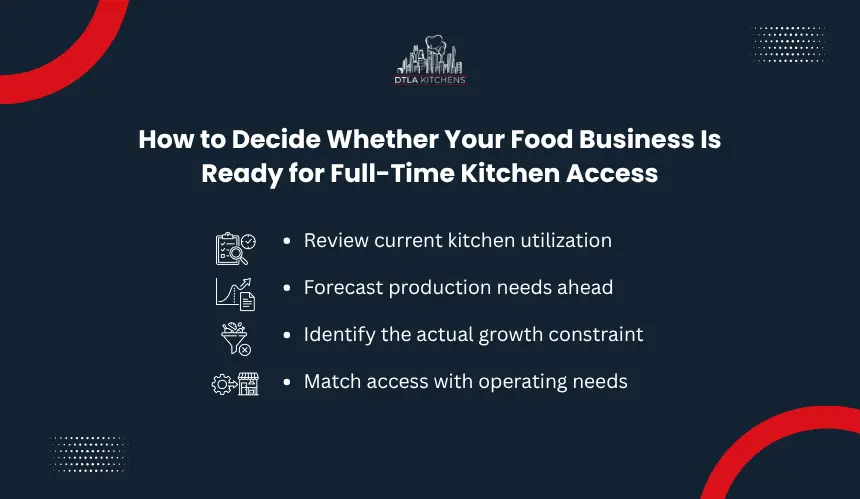
How to Decide Whether Your Food Business Is Ready for Full-Time Kitchen Access
The decision should be based on measurable operating requirements rather than growth expectations alone. A business is ready when its current usage pattern, near-term demand, and production constraints consistently support a higher-access model.
Did you know? A food business can appear busy without actually being ready for full-time kitchen access. Tracking booked hours, productive hours, order volume, and capacity constraints over several months gives a more reliable readiness signal than short-term sales growth alone.
Review Your Current Kitchen Utilization
Start by measuring how often the kitchen is actually used and how much of that time is productive. Track booked hours, active production hours, idle periods, and the frequency of additional sessions requested outside the normal schedule.
A sustained pattern of high utilization provides stronger evidence than occasional busy weeks. If the business repeatedly uses most of its available access and still requires additional production time, the existing model may no longer provide enough capacity.
Forecast Production Needs for the Next Several Months
Current demand should be evaluated alongside realistic near-term growth. Review confirmed catering bookings, recurring customer orders, seasonal peaks, wholesale commitments, planned menu expansion, and any new sales channels expected to increase production requirements.
The forecast should translate expected sales into operational demand. Estimating additional prep hours, batch volume, storage requirements, and equipment use creates a clearer picture of whether full-time access will be needed consistently rather than temporarily.
Evaluate Whether Full-Time Access Removes a Real Growth Constraint
The strongest case for full-time access exists when kitchen availability is the specific factor preventing the business from increasing output or operating efficiently. If additional access would directly allow more orders to be produced, reduce fulfillment restrictions, or support a planned expansion, the upgrade has a defined operational purpose.
If the main constraint is instead weak demand, insufficient staffing, limited working capital, or inefficient production processes, increasing kitchen access may not solve the underlying problem. The facility should address a verified bottleneck, not substitute for broader operational planning.
Choose the Access Level That Matches Actual Operations
Kitchen access should scale with how the business produces, not simply with how large the business appears. Occasional production may remain suitable for hourly or shared access, while recurring but limited schedules can justify part-time arrangements.
Full-time access becomes the stronger fit when production is continuous enough to require regular availability, predictable control over the workspace, and capacity that can support sustained demand. The right choice is the access level that aligns facility costs with the business’s actual operating pattern and expected production load.
Ready to give your food business more room to grow? DTLA Kitchens offers flexible commercial kitchen solutions across Southern California, from part-time and full-time kitchens to bakery, ice cream, kosher, and kitchen studio spaces. Find the setup that fits your production needs and move forward with a kitchen built for your next stage of growth.
Frequently Asked Questions
Full-time access does not automatically mean the kitchen is exclusively yours. Many commissary facilities provide 24/7 entry while workstations, ovens, walk-ins, or specialty equipment remain shared. Before signing, confirm which areas are dedicated, which require reservations, and whether peak-time equipment conflicts could still limit production.
Moving to a full-time arrangement can trigger new paperwork depending on the facility and local health authority. Your business may need an updated permit, commissary agreement, inspection, food-safety certification, or insurance documentation tied to the new location. Verify requirements before production begins, especially if your business address or approved preparation site changes.
Seasonal businesses should compare year-round fixed costs with their highest and lowest production months. A full-time commitment may work during holiday, catering, or farmers-market peaks but become expensive during slower periods. Look for month-to-month, short-term, or hybrid agreements when demand fluctuates instead of assuming an annual full-time lease is necessary.
Ask how the facility handles allergens, shared equipment, sanitation records, and product separation before committing. Businesses producing allergen-sensitive, kosher, gluten-free, or specialty foods may need dedicated storage, controlled prep zones, or validated cleaning procedures. Full-time access provides more availability, but it does not automatically eliminate cross-contact risk in a shared commercial kitchen.
Delivery policies vary considerably between commissary kitchens. Confirm whether shipments can arrive while you are off-site, where ingredients are held, and whether refrigerated or frozen deliveries can be received safely. For high-volume operations, restrictive receiving hours can become a separate logistics bottleneck even when production space is available around the clock.
Do not assume the kitchen operator’s insurance covers your ingredients, finished products, equipment, or losses from refrigeration failure. Shared-kitchen policies and tenant policies may cover different risks. Ask specifically about product liability, spoilage, equipment damage, recalls, and required additional-insured language so you understand which losses remain your responsibility.